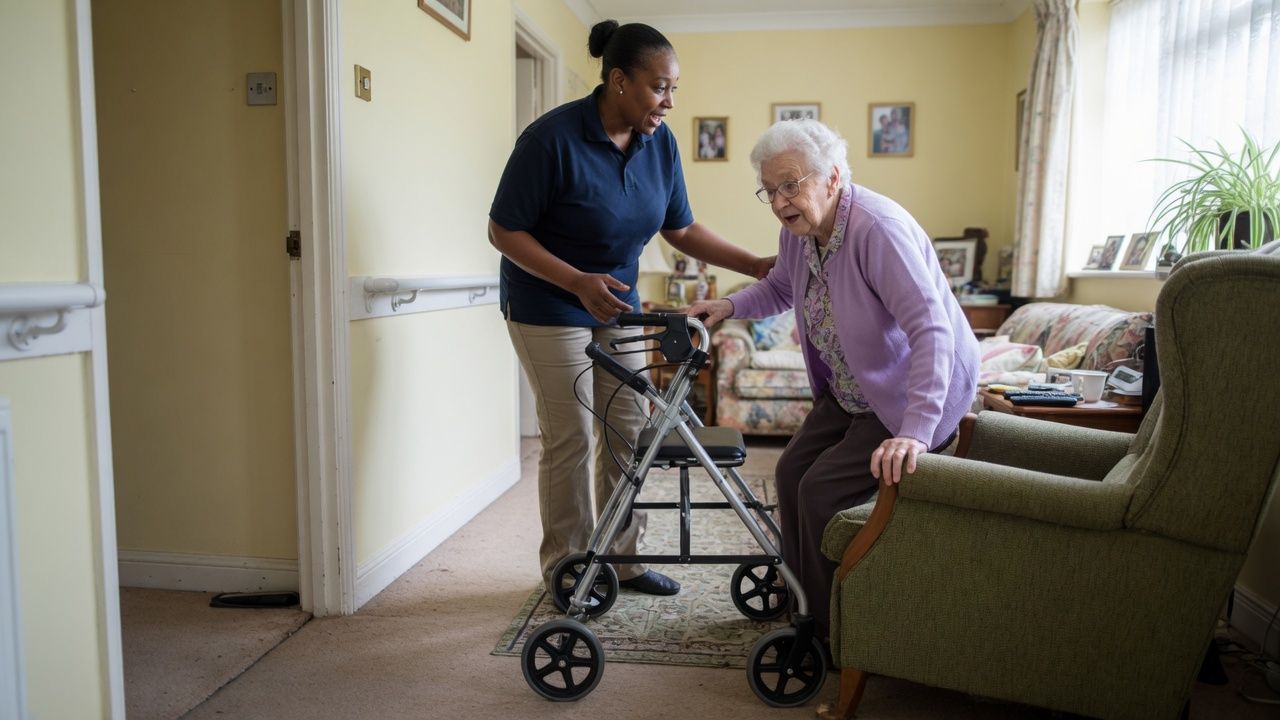


A support worker arrives for the morning visit and finds a bed the family bought online, a hoist borrowed from a neighbour and a bathroom too small to turn a shower chair. Manual handling in client homes differs from a facility because the provider controls the worker's training and method, but not the bed, the room or, often, the equipment.
Safe Work Australia treats people handling as a hazardous manual task, and that duty does not stop at the front door. This is the operational WHS view.
Key Takeaways
- No worker should lift or restrain a person, other than a small infant, alone, so the provider must supply the method, trained workers and enough of them.
- Each item of equipment in a home needs a written position on who checks it, who repairs it and what a worker does when it fails.
- Competency is signed off per type of equipment, not once for manual handling in general.
- A worker can stop a transfer when equipment or staffing is unsafe, and the provider needs a clear path for that decision.
Why a private home changes the manual handling equation
In a facility, the provider chooses the beds, hoists and floor plan. In a home, the client or family did, and the provider walks into the result. Safe Work Australia's guidance for the health care and social assistance industry asks whether the layout leaves space for hoists and walking aids, and whether risk assessments are done before workers visit.
A cramped bedroom is therefore a workplace hazard the provider must eliminate or minimise as far as reasonably practicable. A work health and safety policy should treat the client's home as a place of work and say who decides when the risk is too high.
The people-handling risk assessment before the first service
A people-handling risk assessment sits alongside the home environment risk assessment but looks at tasks, not the house. It records:
- each handling task in the care plan, such as bed to chair, toileting and showering
- the client's mobility, cognition and pain, and how these change across the day
- the layout: bed height, space beside the bed, doorways and bathroom size
- the equipment present, its owner, its condition and whether it suits the task
- the method, the number of workers required and when the client and family were consulted
The method for a particular client comes from the relevant clinician, such as an occupational therapist, not from a template or the worker's judgement on the day. The manual handling and assisted mobility policy should say who completes the assessment and holds the record.
Equipment in client homes: who is responsible
Three ownership patterns
Equipment may be client-owned, supplier-loaned, or funded through the Assistive Technology and Home Modifications scheme, which the AT-HM scheme compliance article covers.
A provider cannot always maintain what it does not own, but it can decide whether its workers will use it. The Department of Health has described a planned national loans scheme that would support repairs to loaned items, but until a client is covered, do not assume anyone else will fix a failing hoist.
The assistive technology and equipment management policy should require a register entry for every item used in a handling task: owner, supplier contact, evidence of the last service and who arranges repair.
Checking equipment before use
Safe Work Australia lists regular equipment inspection as an administrative control. In a home, that means a short pre-use check: brakes, battery charge, sling condition and whether it is the sling the plan names, and the feet of a shower chair. Anything that looks wrong stops the task.
Hoists, slide sheets, transfer belts and shower chairs in practice
Hoists need clear floor space, the sling prescribed for the client and the number of workers the plan states. In a Safe Work Australia case study, a worker used a hoist that was not set up properly and the client was injured.
Slide sheets reduce friction when repositioning in bed, and should not stay under the client unless the plan says so.
Transfer belts suit some clients and not others, so use them only when the plan includes them.
Shower chairs must fit the recess, sit level and stay stable.
Two-person tasks and what rostering has to cover
If the plan calls for two workers, the visit is not a one-worker visit, whatever the roster looks like that morning. Safe Work Australia says providers should have enough workers for people handling.
The rostering policy should treat a two-person visit as one linked booking, and give coordinators a rule for the morning the second worker does not arrive. The first worker does not do the task alone, and the coordinator chooses between waiting, an approved alternative method or rebooking. If the client is in immediate danger, call 000.
Competency sign-off, piece by piece
General manual handling training is not competence on a particular hoist. Safe Work Australia's home-based care case study pairs new workers with experienced ones until they demonstrate competency.
A sign-off record shows the worker, the equipment type and model, the observer, the date and the review date. Sign-off comes before solo use, and a new hoist model or sling type triggers fresh sign-off. The workforce training and competency policy should record sign-off by equipment type and flag when it lapses.
When equipment is unsuitable, faulty or the task cannot be done safely
If equipment is damaged, unfamiliar, wrong for the plan or unusable in the space, the worker stops, does not improvise a lift and tells the coordinator straight away.
The provider needs an on-call contact who can decide, an interim method approved by a clinician, a route back to the therapist for reassessment, and someone to repair the item. Where the client owns it, ask them not to use it until it is fixed and document the request.
Stopping does not mean leaving the person unsafe: escalate through the clinical pathway so care is arranged another way. Explain to the client and family what the equipment does for them, since a hoist can feel like a loss of independence, and record their preferences. A worker who stops in good faith should not face a penalty.
Worker injury and incident response, and the link to post-fall response
When a worker is hurt, make the client safe, give first aid, stop the task, tell the supervisor and record the incident. Check whether the injury is notifiable to your WHS regulator under your jurisdiction's law. The investigation should look at equipment, roster and training before the worker's technique.
If a client is injured during a transfer or is found on the floor, the same stop-and-assess logic applies. The article on fall response during a home care visit explains why every fall belongs in the incident system.
Review triggers and what auditors look for
Safe Work Australia says controls should be reviewed after any change to the task or workplace. Reassess after hospital discharge, a change in the client's condition, new or removed equipment, or a near miss or injury.
The model code of practice on hazardous manual tasks sets out the process of identifying, assessing and controlling risks. The Aged Care Quality and Safety Commission looks at the safety and quality of care and WHS regulators look at the workplace, so a transfer injury can draw both.
Expect requests for the assessment, the equipment register, competency records by equipment type, proof that two-person visits had two workers, and closed-out fault reports. A quick Ask Norma manual handling procedure check before a transfer helps workers confirm the approved method, but does not replace sign-off.
Related Resources
- Manual handling and assisted mobility policy template
- Assistive technology and equipment management policy template
- Fall response in home care
- Home environment risk assessment
- Policy and evidence mapping to the Quality Standards
- Safe Work Australia hazardous manual tasks code of practice
- Department of Health AT-HM scheme page
Frequently Asked Questions
Who arranges a replacement hoist for a Support at Home client?
Assistive technology is funded separately from the quarterly budget through the AT-HM scheme. The item must be on the AT-HM list and match an assessed need. Most items need a participant contribution.
Can a family member act as the second person?
Not by default. A family member is outside the provider's training and sign-off. Agree to it only if the clinician has written the family role into the plan.
What if the client insists on using their old equipment?
Record the conversation, explain the risk plainly and involve the clinician. If the equipment cannot be used safely, the worker does not do the task with it, and an alternative goes into the plan.
Is the model code of practice legally binding, and does WHS law apply in a home?
Safe Work Australia tells readers to check with their regulator whether the code has legal effect in their jurisdiction. On the second point, SafeWork NSW states that when work is conducted in a home, the home is considered a workplace.
Write Transfer Plans for the Actual Home
A transfer plan written for a facility will not survive a narrow hallway or a borrowed hoist. The safe version names the task, the clinician's method, the equipment and its owner, the number of workers and the stop rule. This week, pick your five highest-risk clients and confirm each has an assessment, a register entry with a named owner and at least two workers signed off on the equipment in the home.