

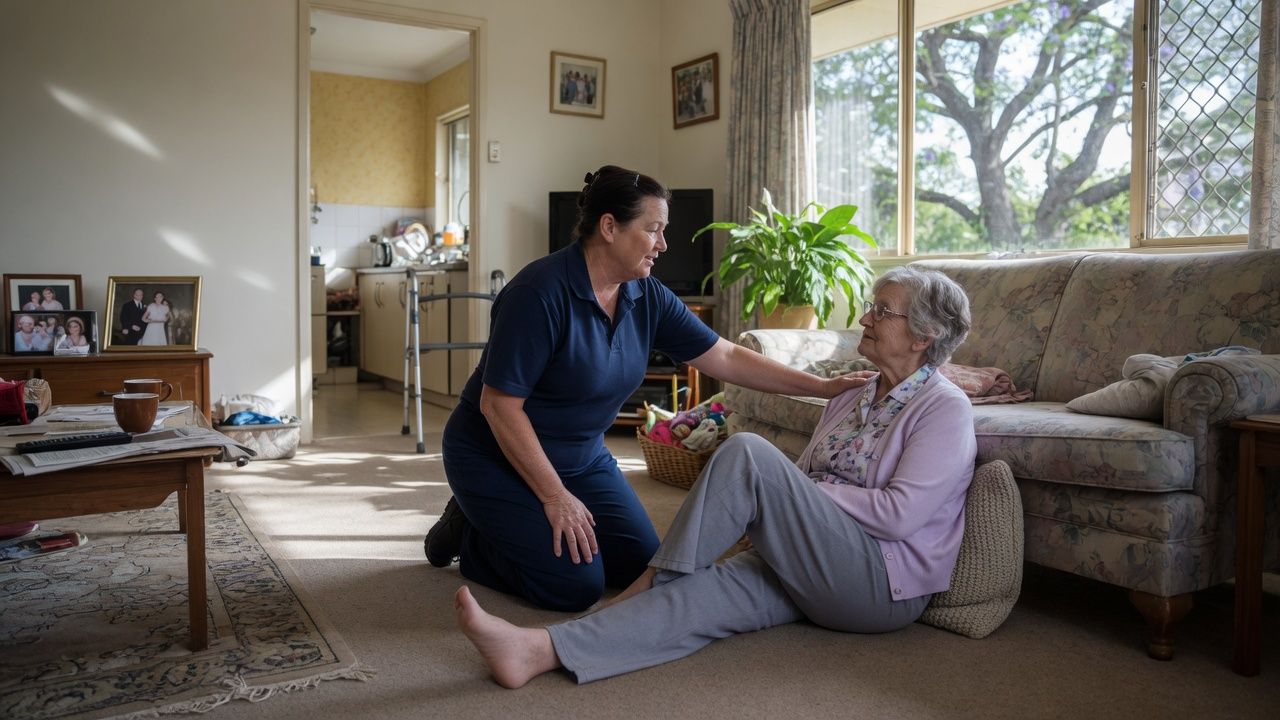


A support worker lets themselves in for the morning visit and finds the client on the lounge room floor. There is no nurse down the corridor, no lifting team and no colleague to ask. A sound fall response in home care rests on decisions made by one person in the first few minutes, and on a provider process they can follow while shaken.
Key Takeaways
- Every fall needs a response, even when the client says they are fine.
- A worker should not lift a client from the floor unless trained, equipped and the client has been assessed as safe to move.
- A head strike, an unwitnessed fall or blood-thinning medicines are escalation triggers, not judgement calls for the worker alone.
- A fall is not automatically reportable under the Serious Incident Response Scheme (SIRS), but every fall belongs in the incident management system.
- A post-fall review is finished only when the care plan has been checked and changed where needed.
Why a fall at home differs from a fall in a facility
In a residential setting, a fall brings a call bell, a registered nurse and often a hoist on the same floor. At home, one worker may be the only person present, with a phone as their main tool. If the client lives alone, nobody can say how long they were down.
The procedure must be short and usable under stress, and sit alongside your arrangements for lone worker safety.
The first two minutes: assess before you act
Speak to the client before touching them. Check they respond and are breathing normally. Ask what happened, where it hurts and whether they hit their head. Look for bleeding, a limb at an odd angle, or signs they have been down for some time.
Gently discourage the client from getting up alone. Keep them warm and comfortable, stay with them, and check the room for hazards. The Australian Commission on Safety and Quality in Health Care states in its falls guidelines for community care that all falls, including those with minor or no injury, must be taken seriously, and that the need for basic life support should be assessed straight away.
When 000 is the answer
Your procedure should name the triggers in plain words. Typical examples are a client who is unresponsive or not breathing normally, severe bleeding, a suspected neck, back or hip injury, a head strike with drowsiness or confusion, chest pain, or signs of a stroke.
When a trigger is met, call 000 first and tell the on-call coordinator afterwards. Stay on the line, follow the call-taker's instructions and do not move the client unless they are in immediate danger. If the worker is unsure, the rule should favour calling.
Lift or no lift: the manual handling duty
The default is no lift. A client who looks unhurt may still have a fracture, a head injury or an unseen cause such as a faint, and hauling them up can worsen the harm and injure the worker. The Safe Work Australia model code of practice on hazardous manual tasks says no worker should fully lift a person, other than a small infant, unaided. Check with your WHS regulator how it applies in your jurisdiction.
In practice, a provider has three options, in order of preference:
- The client is assessed as uninjured and able to rise with verbal coaching, using the method already in their care plan.
- A worker trained in the equipment uses lifting or transfer equipment the provider has supplied for that home and recorded in the plan.
- The worker keeps the client comfortable on the floor and calls for help, either the clinical line or an ambulance.
Your manual handling policy should state which homes have equipment and which workers are trained to use it.
Observation after the fall: head strike and anticoagulants
The Commission's guidelines advise neurological observations if the person hit their head, has new confusion or the fall was unwitnessed. They also say to consider anticoagulant medicines, delirium and sepsis as contributors to deterioration.
Those are clinical tasks. Unless a worker is trained and authorised, their role is to report clearly, and the provider's role is to get a registered nurse or clinical lead on the phone quickly. A good handover covers whether the fall was witnessed, any head strike or new confusion, the medicine list with blood thinners flagged, and what the worker has done.
The clinician decides what monitoring follows, and you should settle in advance who checks on the client if the worker must leave. The home care clinical escalation pathway and your clinical escalation policy are the place to set this out.
Who is told, and when
The on-call coordinator hears first. Once the client is safe, the nominated family member, representative or carer is told, with the client's agreement where they can give it. The Aged Care Quality and Safety Commission's provider handbook says you must assess who needs to be notified, which may include the carer or representative, and use an open disclosure process.
Recording the fall
Write what was found and done, in time order: when and where the client was found, what they said in their own words, what the worker saw, who was called and the advice given, and who was told. Record what was seen, not assumptions such as "tripped on the rug".
Enter the incident in your incident management system the same day. Our guide to home care documentation requirements covers progress notes, and the article on Ask Norma post-fall documentation walks through a tool-led check of the record.
SIRS and other reportable events
A fall on its own is not one of the eight reportable incident types. The Commission's guidance on reportable incidents lists them, including neglect, unreasonable use of force and unexpected death. For home services, all reportable incidents to do with care must be reported, and the scheme covers Support at Home.
A fall becomes reportable when the circumstances fit a type. The Commission's neglect guidance covers a service that puts an older person at risk of serious injury, or a significant failure to provide a service, so a fall linked to a falls strategy in the care plan that was not followed should be assessed against it. Rough handling during a lift could raise unreasonable use of force.
Priority 1 applies where the incident caused, or could reasonably have caused, an injury needing medical treatment, and must be notified within 24 hours of becoming aware. Priority 2 covers all other reportable incidents, with notification within 30 days. Notification goes through the My Aged Care provider portal.
Police must be told within 24 hours if there are reasonable grounds. Your incident management policy should record who makes the reportable decision.
The post-fall review and the care plan
The Commission's guidelines call for every fall to be reviewed and reported, to find how and why it happened and act to reduce the chance of another. They advise a post-fall analysis to inform the care plan, and an in-depth analysis after serious injury or death.
In practice, the care partner or clinical lead looks at the cause, medicines, footwear, the home environment and mobility with the client and their family. Outcomes may include a medicines review, an occupational therapy or physiotherapy referral, equipment, and an updated falls risk assessment, in line with your falls prevention and management policy.
Training, drills and what auditors look for
The guidelines state that the workforce should receive training in post-fall management, reporting and documentation. Short scenario drills work well, such as a client who says "just help me up" or one on blood thinners who hit their head.
An assessor would reasonably expect a written procedure a lone worker can follow, training records, manual handling risk assessments, incident records linked to a documented reportable decision, and evidence that reviews changed care plans. The policy mapping to standards hub helps you match these records to the Quality Standards.
Related Resources
- Falls prevention and management policy
- Manual handling and assisted mobility policy
- Incident management and reporting policy
- Home care clinical escalation pathway
- Policy mapping to the Quality Standards
- Aged Care Quality and Safety Commission
- Australian Commission on Safety and Quality in Health Care
Frequently Asked Questions
Can a support worker help a client up if the client says they are fine?
Only within the provider's procedure. The worker checks for injury and a head strike first, and does not lift the client alone. If in doubt, the client stays on the floor and the worker escalates.
Should a worker call 000 for every fall?
No, but the procedure must say which situations require it, such as unresponsiveness or a head strike with drowsiness. Other falls go to a clinician for advice. When unsure, calling is the safer default.
Is every fall a reportable incident under SIRS?
No. A fall is reportable only when it fits one of the eight reportable incident types, such as neglect. Every fall should still be recorded in the incident management system, with the reason it was or was not treated as reportable.
What if the client refuses an ambulance?
An informed client has the right to decide. The worker records the refusal and the circumstances, and escalates to the clinician and coordinator. The Commission notes that documenting a refusal does not remove the provider's responsibility to provide care if the person is harmed.
A Fall Response Works Only When Rehearsed
A fall at home puts one worker and a handful of decisions in the same room. Providers that write down the first-minute steps, the lifting limits and the reporting thresholds, and rehearse them, give that worker something solid to rely on. Read your current falls procedure as a lone worker would, and mark every step that depends on someone who is not in the room.


