

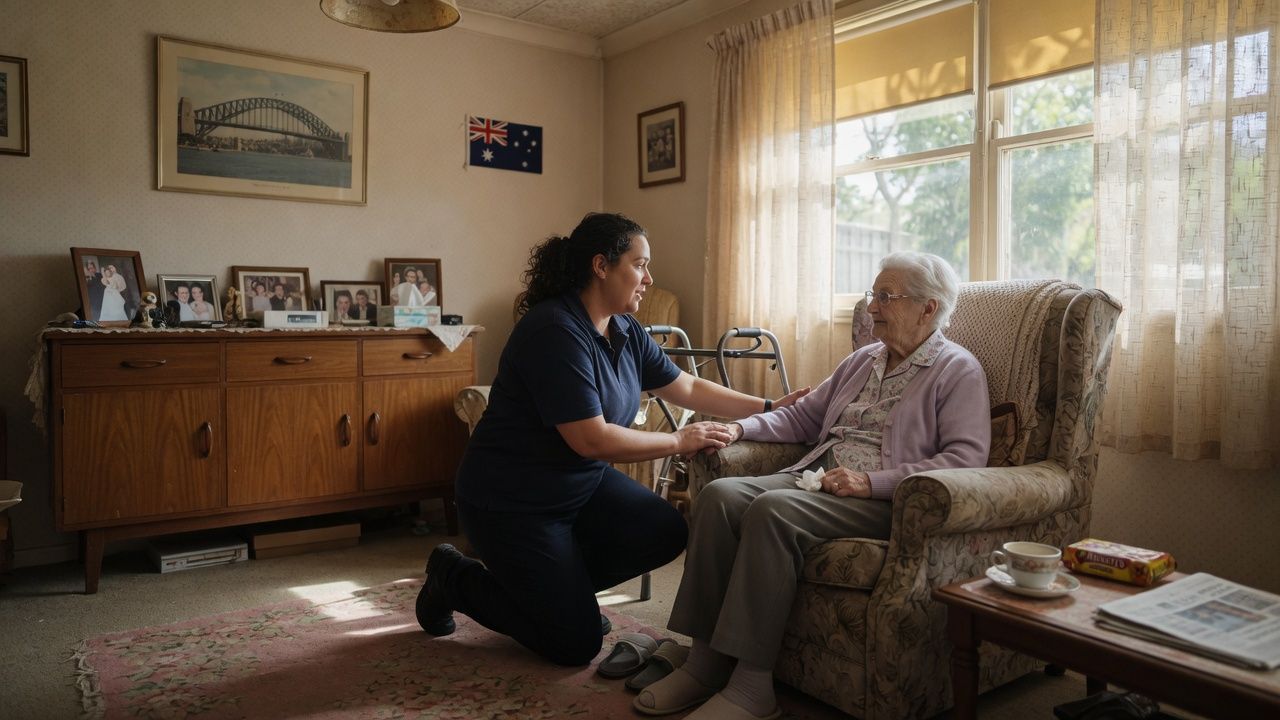


A home care clinical escalation pathway is the written route a worker follows when a client gets worse during ordinary business hours: who to tell, how fast, and what to write down at each step. Home care has no nurses' station down the corridor. The pathway has to work from a kitchen table, over a phone, operated by a support worker who may be the only person to have seen that client in three days. This guide covers the in-hours pathway: recognise, respond, escalate, review.
Overnight and weekend cover is a different design problem with different risks. For the on-call roster, triage trees and ambulance thresholds that apply outside business hours, read our guide to after-hours on-call escalation in home care. What follows is general guidance for providers and team leaders, not legal advice, and it should be read alongside your own policies and the terms of your clients' care agreements.
The duty behind this pathway sits in Outcome 3.2 guidance from the Aged Care Quality and Safety Commission. Action 3.2.5 asks providers to support aged care workers to recognise risks to a person's health, safety and wellbeing, to identify deterioration or change in daily function, cognition or condition, and to respond to and escalate those risks in a timely manner. Action 3.2.4 adds timely referrals, including to health professionals and to My Aged Care. The Commission sets the duty. The clock is yours to write.
Why the In-Hours Pathway in Home Care Differs From After Hours
After hours the problem is scarcity: few people, long distances, no backup. In hours it is the opposite. Help is available, and the delay comes from diffusion of responsibility. The worker tells the scheduler, who messages the coordinator, who is on another call, and no single person owns the clinical decision. By then the visit has ended and the worker has driven to the next house.
A deteriorating client escalation procedure home care teams can actually follow removes that ambiguity by naming a role, not a person, for every trigger, and by giving the worker explicit permission to skip levels when the sign is serious. Write the chain once and apply it to every worker, including agency and subcontracted staff, through your Clinical Handover and Escalation Policy Template. Record each client's named escalation contacts in the care plan itself, using your Support at Home care partner and care plan policy template, so a worker covering an unfamiliar run is not guessing who to ring.
Step One: Recognise Deterioration Against a Known Baseline
Recognising deterioration in home care is comparison, not measurement. Most support workers do not take clinical observations and are not expected to. What they can do better than anyone is notice that this visit is not like the last one, and that only works if the baseline is written somewhere the worker can read before knocking. Define deterioration for your workforce in plain terms, then list the signs that trigger the pathway. The ones that matter most in home care are the ones a family can explain away:
- New confusion or drowsiness, or a change in how the client speaks, especially if it came on over a day or two.
- Reduced food or fluid intake, or a client with no drink since the last visit.
- New or worsening pain, or pain somewhere the client has never complained about.
- A change in continence, or new reluctance to stand, walk or transfer.
- Breathlessness at rest, new swelling, or skin that is cold, clammy or newly discoloured.
- Medication left in the dose box, or a client who cannot say whether they took it.
- A fall, a near fall, or unexplained bruising, even if the client insists they are fine.
What the note must record at recognition
This is where most escalation records fail. The worker writes a conclusion instead of an observation, and three weeks later nobody can tell what was actually seen. Record what you observed, not what you think it means:
- The time you observed it, which is not the time you wrote it up.
- What you saw, heard or smelled, in plain description, plus the client's own words in quotation marks.
- The baseline you compared against, and where it came from.
- Who else was present, including family or another service.
Step Two: Respond Inside Scope of Practice
Responding is not treating. The worker's job is to keep the client safe, gather what the clinician will ask for, and avoid making things harder to assess.
For red flag signs the response is to call triple zero first and the provider second. Chest pain, signs of stroke, severe breathlessness, uncontrolled bleeding, a client who cannot be roused, or a fall with suspected head or hip injury are not internal escalations. For everything else the worker stays with the client where it is safe, makes the environment safe, and phones the named clinical contact before leaving the home.
Two things workers must not do, and your policy should say so in these words: do not give, withhold or adjust a medication outside your authorised role on the strength of what you are seeing, and do not lift a client off the floor after a fall with suspected injury. Both are common, both are well meant, and both destroy information somebody else needs.
What the note must record at response
- Every action you took, with the time, including the safety steps.
- Anything you deliberately did not do and why, such as medication withheld pending advice under policy.
- How the client responded to what you did.
- Whether the client consented, declined, or could not indicate a preference.
Step Three: Escalate to a Named Role, Not an Inbox
An escalation that lands in a shared inbox has not been escalated. In hours the worker phones a named role, speaks to a person, and comes away with an instruction. A message in the rostering app records an attempt, not a handover.
Give workers a structured way to speak so the call takes ninety seconds rather than five minutes of narrative: identify yourself and the client, state the situation in one sentence, give the background that matters, and ask the question you need answered.
Escalation rarely stops inside the organisation. The same event may call for a GP contact, a referral to another health professional, a My Aged Care re-assessment where a Support at Home participant's function has shifted, notification of the client's representative in line with their consent, and an incident report where harm occurred or nearly occurred under your Incident Management and Reporting Policy Template.
What the note must record at escalation
- The exact time of the call and the method, including failed attempts.
- The name and role of the person you reached, not just the department.
- What you told them, summarised against the structure you used.
- The instruction you were given, in their words, and the time you received it.
- Who else was notified, when, and what they were told.
Step Four: Review, Update the Plan, Close the Loop
The review step is the one providers skip, and the one an auditor can see is missing. An escalation that produced an instruction and no follow-up looks, in the record, like an escalation that was ignored.
Somebody named has to confirm the instruction was carried out, check whether the client's baseline has moved permanently, and update the care plan and escalation triggers if it has.
Where the event showed the pathway itself did not work, that belongs in the trend review under your Clinical Governance Framework Policy Template rather than in one client's file alone.
What the note must record at review
- Which actions from the escalation were completed, by whom, and when.
- The outcome for the client, including a return to baseline.
- Any change to the care plan, the escalation triggers or the visit schedule.
- The next review point and who owns it.
Escalation Timeframes You Can Defend
Escalation timeframes are a provider policy choice. The Commission requires timely escalation without publishing a stopwatch, so the defaults below are drafting suggestions a provider can adopt, document and be held to. A written clock you meet is worth more at audit than an undefined promise to act promptly.
- Red flag signs - Response: call triple zero, then the provider; Escalation: immediate; Note written: before leaving the home.
- Acute change during a visit - Response: phone the named clinical contact from the home; Escalation: within the visit; Note written: before leaving the home.
- New change that is not acute - Response: phone the care partner or clinical lead; Escalation: same working day; Note written: end of shift.
- Gradual change across visits - Response: raise at the next clinical review; Escalation: next working day; Note written: end of shift.
Related Resources
- Set your handover structure and escalation chain with the Clinical Handover and Escalation Policy Template.
- Record named escalation contacts using the Support at Home care partner and care plan policy template.
- Decide what becomes a reportable event with the Incident Management and Reporting Policy Template.
- Place escalation inside your assurance cycle with the Clinical Governance Framework Policy Template.
- Design the out-of-hours half with our guide to after-hours on-call escalation in home care.
- Give workers a shared definition of deterioration.
- Read the regulator's wording in Outcome 3.2 guidance from the Aged Care Quality and Safety Commission.
Frequently Asked Questions
Who should a support worker call first when a client deteriorates?
For red flag signs, triple zero first and the provider immediately after. For everything else, the named clinical contact for that client, taken from the care plan rather than from memory or a group chat.
How quickly must deterioration be escalated in home care?
The Commission requires escalation in a timely manner but does not publish fixed intervals. Providers set their own defensible timeframes in policy, publish them to workers, and show records that match them.
Can a support worker withhold medication if a client seems unwell?
Only where the provider's medication policy authorises it for that situation and role. The safer pattern is to withhold nothing on personal judgement, phone the clinical contact, and record the advice and the time it arrived.
Does every escalation need an incident report?
No. Escalation and incident reporting are separate processes that often overlap. An incident report is triggered by harm or a near miss, so a deterioration caught early and managed well may generate a clinical note and no incident report.
Where should the escalation be documented?
Escalation documentation belongs in the client's clinical record, not only in a message thread or a handover sheet. If the detail lives in the rostering app, copy it into the record the same day, because that is where an assessor looks.
Escalation Lives Or Dies In The Note
A worker who recognised a change, rang the right person and followed the instruction has done the job. If the note does not show the time of the observation, who was called, what they said and what happened next, none of that work exists for anybody reviewing the file later.


