

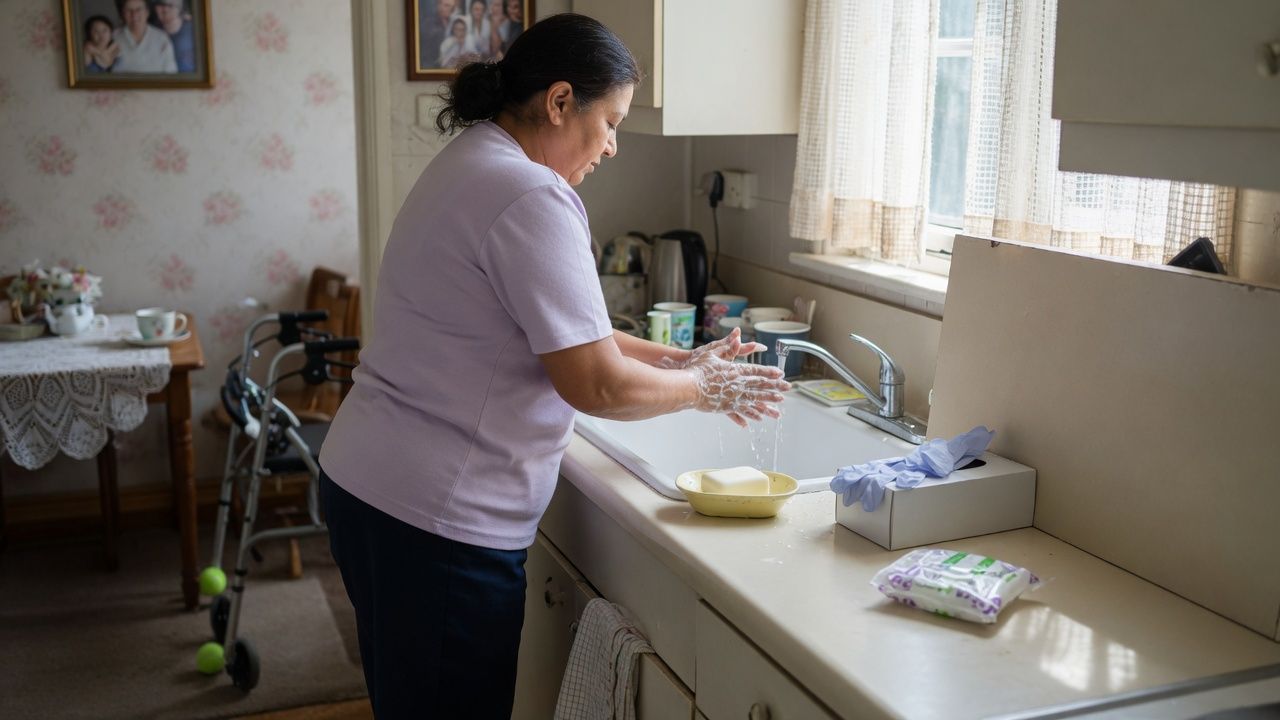


Infection prevention and control in home care has to work without a sluicing room, a linen service or an infection control team on site. The worker has a bag, a car and whatever the kitchen sink offers. Under the strengthened Aged Care Quality Standards, which took effect on 1 November 2025, the provider is still responsible for how that works.
Key Takeaways
- Standard precautions apply on every visit, whether or not anyone seems unwell. Transmission-based precautions are added when infection is suspected or confirmed.
- Workers should carry their own hand rub, wipes, PPE and waste bags, because a client's home may supply none of them.
- PPE follows a task-by-task risk check, and comes off before the worker leaves the area where it was used.
- Official guidance sets the nurse IPC lead requirement for residential care homes and asks home care providers to look for ways to appoint a worker or team to oversee their system.
Why a Private Home Is an Uncontrolled Environment
In a private home the surfaces, pets, bathrooms and bins belong to the client, and several workers or providers may visit the same person in a week.
The Aged Care Quality and Safety Commission notes that workers moving between homes can spread infection between people. Its Standard 4 outcome asks for a system that describes standard and transmission-based precautions appropriate for the setting and makes PPE available.
Standard and Transmission-Based Precautions on a Visit
Standard precautions are the minimum for every client, every time: hand hygiene, appropriate PPE, safe handling of sharps, waste and linen, respiratory hygiene, and cleaning. People can be infectious before symptoms show, which is why IPC on home care visits cannot wait for a diagnosis.
Transmission-based precautions are added when infection is suspected or confirmed. The Australian Commission on Safety and Quality in Health Care publishes an Aged Care Infection Prevention and Control Guide (the guide) that covers contact and respiratory precautions. It warns that prolonged isolation can harm older people. The national infection control guidelines remain the reference, and procedures must translate them for a support worker in a client's bathroom.
Hand Hygiene in Client Homes When There Is No Basin
The guide expects home and community providers to give each worker their own alcohol-based hand rub, and to identify usable hand washing facilities during the environmental risk assessment. It says hand rub should be available even where a basin exists.
Soap and water is still used when hands are visibly dirty, after toileting, and with infections such as norovirus. Neutral hand wipes may be considered where it is not available. Clean hands before gloves go on, after they come off, and after handling laundry, equipment or waste.
Deciding When PPE Is Needed for Home Care Workers
PPE is a per-task decision. The guide asks workers to consider the likely exposure site, the body fluid involved, and whether the client has a suspected or confirmed infection. Taking a blood pressure rarely needs PPE. Helping with a shower carries a splash risk and needs a quick assessment first.
Gloves are for blood or body fluids, broken skin, mucous membranes or chemicals, and come off between tasks. The guide notes gloves are often overused. A procedure should also cover:
- PPE comes off before leaving the area where it was used, which in a home may be one room or one task.
- P2/N95 respirators are for high-risk tasks such as aerosol-generating procedures for someone with a suspected respiratory infection, with a fit check each time.
- If the cause of symptoms is unknown, the most protective relevant precautions apply until it is confirmed.
A home environment risk assessment shows the worker where the basin and bin are.
The Minimum Kit a Worker Carries
The Australian Commission on Safety and Quality in Health Care's guidance for community health services lists a basic kit for offsite visits: alcohol-based hand rub, tissues, paper towels, neutral detergent and disinfectant wipes, PPE, waste bags, plus a puncture-resistant sharps container and spill kit if needed. It advises checking stock for expiry and damage.
Home care providers can adopt that list, name someone to restock it, and record the checks.
Cleaning Shared Equipment Between Clients
Cleaning uses neutral detergent, water and friction, with disinfection where needed. The guide names commodes, blood pressure machines and nail clippers as reusable items to reprocess between people.
Decide which items travel with workers, which stay in the home, and who cleans each. Use disinfectants to the manufacturer's instructions and put the cleaning step on the task sheet.
Soiled Laundry, Clinical Waste and Sharps in the Home
Laundry
Take a linen bag to where the work is happening instead of carrying soiled linen through the home. Linen soiled with body fluid goes into a sealed leakproof bag, filled no more than three-quarters. Where soiling comes from incontinence, align the steps with your continence management in home care process.
Waste
Australia has no national definition of clinical waste, and community services must follow state or territory rules. Your environmental health and waste management policy is where local requirements and worker equipment should be written down.
Sharps from insulin and injections
Whoever uses a disposable sharp is responsible for disposing of it straight away. Clients who self-manage injections should have a suitable sharps container or a safety-engineered device, and workers can point them to local disposal options.
Sharps generated by a worker go into a closed container, carried in a car compartment separate from the driver, and on to a hospital, community health centre or multi-purpose service. Your home care medication safety process should say who may handle injectable medicines.
A needlestick policy should cover first aid, risk assessment and post-exposure advice, including out of hours.
Unwell Workers and Unwell Clients
The guide's principle is that workers should not attend work with symptoms of a potentially infectious disease such as influenza, COVID-19 or gastroenteritis. Write exclusion rules down, and do not penalise people for staying home.
When a client shows symptoms, the worker notifies the person responsible for IPC, the care coordinator or a manager, who considers contacting the client or carer so a risk assessment can decide how services continue. Decide in advance who makes that call.
Respiratory Season, Outbreak Triggers and Vaccination
Plan for seasonal risks such as influenza early. The Department of Health, Disability and Ageing defines an outbreak in an aged care home as two or more residents testing positive within 72 hours, and notes this varies by state and territory. That does not map onto dispersed home care clients. Set your own trigger in an outbreak management policy, agree it with your local public health unit, and record who notifies whom, since notification rules differ by jurisdiction.
The Standard 4 outcome asks for risk-based screening and immunisation for clients and workers. The guide says vaccination should be actively promoted, and not mandated unless a state or territory rule requires it.
Training and Competency
Teach the tasks workers actually do: hand hygiene, PPE, laundry, waste and sharps. Anyone doing wound care needs aseptic technique training and a practical assessment. Track completion through a workforce training and competency policy.
The IPC Lead and Governance Reporting
For residential care homes the IPC lead must be a nurse who has completed, or is completing, specialist IPC training. For home and community providers, the Department of Health guidance on IPC leads says to look for ways to appoint a worker or team to oversee the IPC program. Our post on infection prevention and control in aged care covers the residential role.
Put hand hygiene audits, kit checks, exposure incidents, vaccination coverage and client infections on the clinical governance agenda.
What Audit Evidence Looks Like
The Commission runs infection control spot checks and publishes IPC self-assessment checklists. Useful evidence includes:
- A current infection prevention and control policy naming who oversees it.
- Hand hygiene product availability checks, which the guide suggests running regularly, for example monthly.
- Hand hygiene audits and competency sign-offs.
- Training, screening and vaccination records.
- An outbreak plan with trigger points and notification contacts.
The policy and evidence mapping page shows where each document sits against the Quality Standards.
Related Resources
- Infection prevention and control policy template
- Outbreak management policy template
- Workforce training and competency policy template
- Home environment risk assessment for home care visits
- Policy and evidence mapping to the Quality Standards
- Department of Health guidance on IPC leads
- Australian guidelines for infection control in healthcare
Frequently Asked Questions
Do home care providers need a nurse as IPC lead?
The nurse requirement in the published guidance applies to residential care homes. Home and community providers are asked to look for ways to appoint a worker or team to oversee their system.
Should workers wear gloves on every visit?
No. Gloves are for contact with blood, body fluids, broken skin, mucous membranes or chemicals. Overuse leads to missed hand hygiene.
Who handles a client's own used sharps?
The client is responsible for their own sharps. The provider checks a suitable container is in place and points to local disposal options.
Is there a national rule for declaring a home care outbreak?
The published definition covers residential aged care homes. Set a trigger in your outbreak policy with your public health unit.
Infection Control That Travels With the Worker
A home visit has no sluice room, so infection control has to travel in the bag, the training and the rostering rules. Write precautions for the real setting, name someone to oversee them and keep simple evidence. Start by checking one worker's kit.


