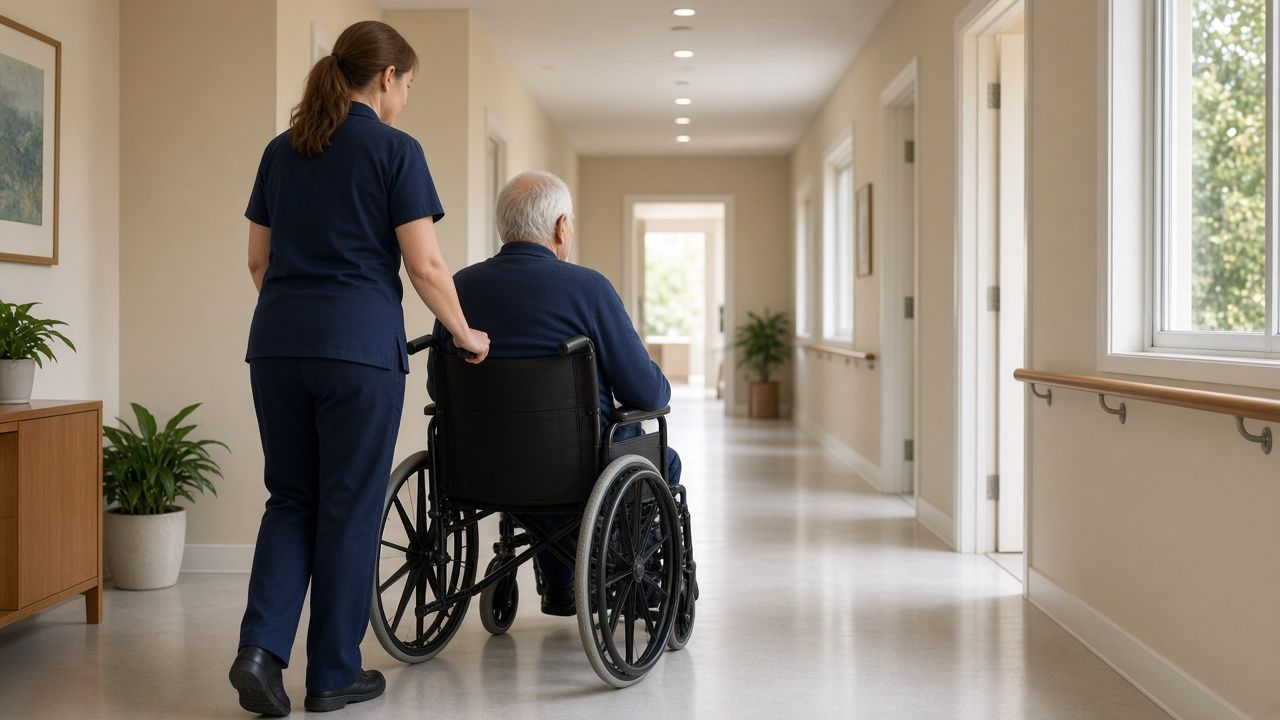


Non-ambulant in aged care means a person cannot walk independently. They move by wheelchair, hoist or bed, and need another person or equipment to get from one place to another. It does not mean bed-bound, and it does not mean the person cannot take part in daily life.
For providers the label sets off three jobs: a mobility assessment, a care plan covering transfers and equipment, and an individual emergency evacuation plan, in residential care and under Support at Home. This is general information, not legal or clinical advice.
Key Takeaways
- Non-ambulant means a person cannot walk independently. It describes how they move, not how capable they are.
- A non-ambulant care plan records transfers, equipment, the workers each move needs, and falls and pressure risk.
- Every non-ambulant person needs an individual evacuation plan naming the method, equipment and workers on each shift, because emergency services may be delayed.
- In home care the plan must work when one worker is alone with the client.
What does non-ambulant mean in aged care?
Non-ambulant describes a person who cannot walk independently. The non-ambulant glossary entry gives the short definition.
Services use the word differently, so write your definition into your policy. Some include people who can take a few steps only with hands-on help, while others mean people who cannot bear weight at all. Those groups need different transfer and evacuation methods.
Common misunderstandings
- It does not mean bed-bound. Many non-ambulant people sit out for meals, join activities and go outside in a wheelchair.
- It does not mean unable to help. Some people can bear weight briefly, and the plan should record exactly what they can do.
- It is not always permanent. Mobility changes after a fall or illness, so review the label.
How is it different from limited mobility?
Limited mobility usually means a person walks with a frame, a stick or supervision. A non-ambulant person cannot leave a room by walking, so no plan should rely on it.
How should mobility be assessed and recorded?
Assess mobility on entry or service start, after any fall or hospital admission, and when a worker notices a change. A clinician such as a physiotherapist or registered nurse should carry it out or approve it. The record should cover:
- how the person moves between bed, chair, toilet and shower
- whether they can bear weight, and for how long
- the equipment used and the workers each task needs
- fear, pain or resistance that affects moving them.
The last point matters because the Safe Work Australia model code of practice on hazardous manual tasks lists handling a person who suddenly resists or stops assisting as an example of sudden force.
What should a non-ambulant care plan contain?
A usable care plan turns the assessment into instructions a new worker could follow on their first shift.
- Transfers: method, equipment, number of workers, and any step never done alone.
- Equipment: type, sling or cushion, and who checks it and how often.
- Repositioning, falls and pressure injury risk: frequency, skin checks, seating time, and when to escalate to a clinician.
- Dignity and preference: how the person likes to be moved and what they are told beforehand.
- Emergency: a cross-reference to their evacuation plan.
Write the plan with the person and their representatives.
What are the safe handling duties for transfers and equipment?
Under the model work health and safety laws, a business must eliminate the risks from hazardous manual tasks or, if that is not reasonably practicable, minimise them so far as is reasonably practicable. The model code counts moving any person as a manual task. States and territories apply their own versions, so check yours.
In practice that means choosing equipment from the assessment, training workers on each item, servicing equipment on a schedule, consulting workers, and reviewing controls after any injury.
Your manual handling and assisted mobility policy sets these expectations once, and each care plan applies them to one person. Client homes bring different equipment, space and staffing, covered in manual handling in client homes.
How do falls and pressure injury connect?
A fall during a transfer is a handling problem as much as a person problem, so the review should cover equipment, staffing and method. Link the plan to your falls prevention policy so follow-up lands in one record.
Long periods in one position raise pressure injury risk, and workers observe, record and escalate to a clinician. For home care, see pressure injury prevention in home care.
How do you plan an emergency evacuation for people who cannot walk?
The Department of Health, Disability and Ageing says all aged care services must have an emergency management plan with worker roles before, during and after an emergency. Its guidance on service continuity and emergency events also says the plan should cover evacuation, including transport and care, because emergency services may be delayed. Its example is ambulances being unavailable during a bushfire.
That is why non-ambulant people need individual plans: a site plan saying "evacuate residents to the assembly point" assumes everyone can walk there. Your emergency and disaster management policy sets the framework, and each non-ambulant person then needs a plan of their own inside it.
Residential aged care
An individual plan should state:
- the evacuation method, agreed with the person's clinicians and your fire safety adviser
- the equipment and where it is kept
- how many trained workers the move needs
- where the person is taken and what goes with them.
Test staffing shift by shift. A plan needing three workers is only a plan if three trained workers are on the floor at night. If it fails, change the roster, the method or the room allocation.
This article does not set evacuation techniques. Take the method from your fire authority, fire safety adviser and the person's clinicians, as fire requirements differ by state and territory. The Department also notes it cannot provide evacuation support such as transport during an emergency, so your plan has to stand alone.
Home care and Support at Home
In a client's home one worker is often alone with a non-ambulant client. The plan should say what the worker does if a move is beyond what one person can safely do, who they call, and how emergency services are told the client cannot walk.
The Department says Support at Home providers should make welfare checks during an emergency, by phone if they cannot visit. Put non-ambulant clients high on that list, especially in the higher-risk weather season, October to April. The wider plan is in emergency planning for home care clients.
How often should drills run, and what evidence do you keep?
Drills show whether the plan works with the equipment and staff actually on shift. Set the frequency in line with your fire authority's requirements and run drills across shifts, including nights.
Record the shift, participants, time taken and equipment problems, then update the individual plan. Evacuation drills covers how to run them safely. The Department also says to review and update your emergency management plan every year.
What do auditors look for?
Reviewers ask whether the plan matches practice. Expect to show:
- a current mobility assessment for each non-ambulant person, dated after any change
- care plans that match what workers do
- evacuation plans naming equipment and workers
- training and drill records with fixes completed
- an emergency plan reviewed within the past year.
Related Resources
- Non-ambulant glossary entry
- Manual handling and assisted mobility policy template
- Emergency and disaster management policy template
- Safe evacuation drills in aged care
- Policy mapping to standards
- Department guidance on emergency events in aged care
- Safe Work Australia code on hazardous manual tasks
Common Questions About Non-Ambulant Care
1. What does non ambulant mean?
It means a person cannot walk independently and relies on a wheelchair, hoist, bed or another person to move. It says nothing about their awareness or wishes.
2. Is a non-ambulant resident the same as a bed-bound resident?
No. A bed-bound person spends nearly all their time in bed, while a non-ambulant person may be up in a chair most of the day. Both need plans that do not rely on walking.
3. Who decides how a non-ambulant person is moved in an emergency?
The provider owns the plan, built with the person's clinicians, a fire safety adviser and the fire authority's requirements. Workers follow it and call 000 early.
4. What changes for non-ambulant clients in home care?
One worker is often alone with the client, so the plan must cover what that worker does, who they call and how emergency services learn the client cannot walk.
5. How often should mobility be reassessed?
Set a regular review interval in your policy with your clinicians, and reassess sooner after a fall, a hospital stay or a change in health. Update the care plan and evacuation plan together.
Know who cannot walk before the alarm
An emergency tests the plan you have, not the one you meant to write. For a non-ambulant person that means a current assessment, a care plan workers follow and an evacuation plan with named equipment and staff. List every non-ambulant person you support today, then test one evacuation plan against tonight's roster.