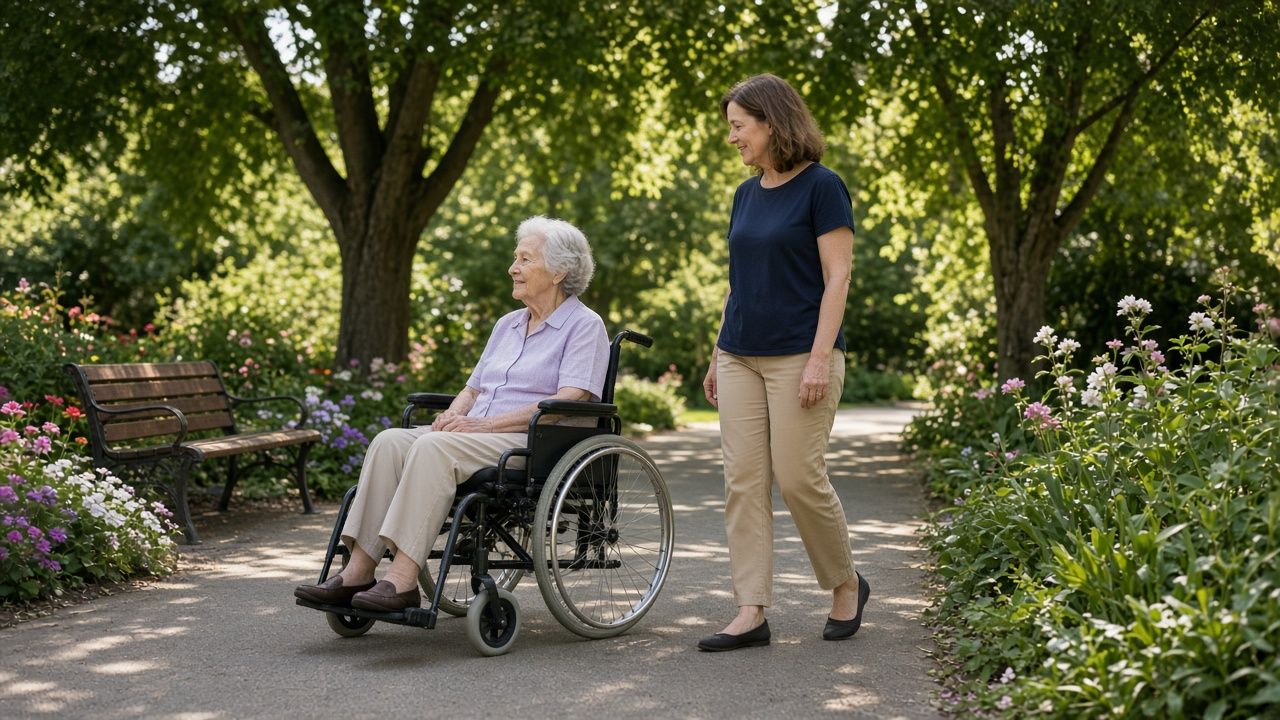


Under the Strengthened Aged Care Quality Standards, residential and other centre-based providers must make sure people can move freely both indoors and outdoors. That puts outdoor spaces in aged care inside the service environment obligation, so paths, shade, gates, seating and garden maintenance are compliance matters as well as lifestyle ones.
Key Takeaways
- Outcome 4.1b requires providers to deliver services in a clean, safe and comfortable environment, and its actions include enabling people to move freely both indoors and outdoors.
- A 2026 Sydney study of 1,031 older adults found more neighbourhood tree canopy was associated with fewer depressive symptoms, but it shows association rather than cause and did not test aged care gardens.
- A secure garden should be designed and risk assessed as the least restrictive option, and any control that limits a person's movement belongs in the restrictive practices system.
- Outdoor time belongs in care and services plans and the lifestyle program, because a garden nobody can reach does not meet the outcome.
- Hazard inspections, maintenance logs and resident feedback are the records that show outdoor areas are managed.
Why do outdoor spaces matter for older people's wellbeing?
The best recent Australian evidence concerns trees near people's homes. A study in the Journal of Affective Disorders (2026), by Reppermund and colleagues at UNSW Sydney and Australian Catholic University, followed 1,031 adults aged 70 to 90 from the Sydney Memory and Ageing Study for up to 12 years. It measured tree canopy within 1 km of each home and found higher average canopy was associated with lower depression scores.
Read it modestly. The authors say causality cannot be inferred, participants lived mostly in areas of average or higher socioeconomic status, and the study did not look at aged care gardens. It also reported an odd result: increases in canopy over time were linked to more depressive symptoms, but this appeared only in people who moved house, and among movers whose reason was recorded, about half had moved into residential aged care and a third cited physical illness. The authors attribute that to relocation.
Good practice reading: green surroundings alone do not help someone who cannot reach them. Getting outside safely, when they choose, is the part a provider controls. Governa's guide to physical environment risks covers the wider building hazards.
What does the service environment standard require for outdoor spaces?
Outcome 4.1b sits in Standard 4 of the Strengthened Aged Care Quality Standards from the Department of Health, Disability and Ageing. The Department states that the Aged Care Rules 2025 make the outcome statements legal obligations. The actions describe what providers can do to meet them.
- The outcome: people must be able to access services in a clean, safe and comfortable environment that supports belonging, interaction and function.
- Outdoor movement: an action says the service environment enables people to move freely both indoors and outdoors.
- Accessibility and design: the environment must be accessible, including for people with a disability, and promote movement, engagement and inclusion through design.
- Unobtrusive safety: safety risks should be reduced unobtrusively and the environment should be easy to find your way around.
The Aged Care Quality and Safety Commission's guidance on Outcome 4.1b says a service environment can include gardens, and tells providers to use their risk management system (Outcome 2.4) to identify, assess, document, manage and review environmental risks. It also says to design and maintain the space in partnership with older people. For Support at Home, Outcome 4.1a is narrower: where services are delivered in a client's home, the provider identifies environmental risks and discusses options with the client.
How do you design safe, accessible garden and outdoor areas?
Walk the route from each wing to the garden as a wheelchair or walker user would. What follows is good practice, not text from the Standards:
- Paths: smooth, wide, firm surfaces, no lips at thresholds, gentle gradients and a loop that returns to the start.
- Seating: benches at regular intervals, some with arm rests, in both sun and shade.
- Shade and heat: mature trees or covered areas, drinking water within reach and a rule for moving people indoors in hot weather.
- Trip hazards: uneven pavers, roots, hoses, drains and wet moss, checked against your falls prevention policy.
- Plants: check beds against a reputable toxic-plant list and avoid toxic species where residents may taste or pick plants.
- Water features: assess ponds and fountains for drowning and slip risk, and fence or remove them if the assessment says so.
- Lighting: light paths and doors used near dusk; the Commission names poor lighting as an environmental risk.
How do you keep a dementia friendly garden secure without it becoming a restrictive practice?
A garden that people living with dementia can use freely is often the least restrictive way to balance safety and freedom of movement. The Commission's guidance gives the example of a fence around a secure area that is designed to blend into its surroundings or is hidden with plants, and says the controls should be risk assessed. The aim is to reduce risk with the least restriction on a person's freedom.
The Standards separately require providers to minimise restrictive practices, using them only as a last resort, in the least restrictive form, for the shortest time needed, with informed consent, and with monitoring and regular review (action 3.2.7). Whether a particular gate, keypad or locked door amounts to a restrictive practice for a given person is a legal and clinical judgement. Confirm it with your own legal adviser and the person's clinicians, and record the outcome.
- Individual assessment: decide who needs support to go outside and who is simply being kept in, using the dementia care policy and clinician input.
- Positive risk-taking: record what the person values about being outdoors, in line with the dignity of risk policy and Standard 1 (action 1.3.5).
- Missing person plan: keep a current elopement and missing person policy, with perimeter checks and a clear response if someone leaves.
- Restrictive practice route: if a barrier restricts a specific person's movement, move it into your restrictive practices policy process.
How do you help people get outside and prove it?
Care and services plans must describe a person's needs, goals and preferences and include strategies for managing risk (action 3.1.1 and 3.1.4). Add outdoor preferences: favourite spot, preferred time of day, who helps, sun and heat precautions, and whether supervision is needed. Staff then know a morning in the garden is part of the person's care.
Build the same thing into the lifestyle and recreational activities policy and the activity calendar. Gardening groups, raised beds at wheelchair height and shared meals outdoors give people a reason to go. Ask residents what they want, because the Commission's guidance calls for design in partnership with older people.
What will an assessor see on a walk-through?
This is a good practice self-check, not an official checklist:
- Observation: can a person in a wheelchair reach the garden unaided, and are paths clear, shaded and in good repair?
- Hazard records: dated inspection sheets for paths, plants, furniture, fencing and water features, with defects closed out.
- Maintenance logs: grounds and tree work schedules, and who is accountable when a contractor does the work.
- Risk register: outdoor risks entered and reviewed under the risk management policy, consistent with Outcome 2.4.
- Individual evidence: care plan entries on outdoor time and supervision, and any restrictive practice consent and review.
Governa Connect maps an organisation's policies to the Strengthened Aged Care Quality Standards, so a provider can see where its environment policies sit against Standard 4. Governa also publishes free policy templates for the topics above.
Outdoor access is a daily care task
The tree canopy research supports offering green space but cannot show a garden alone lifts a resident's mood. The Standards ask for something narrower and easier to act on: a safe, accessible environment where people can move freely outdoors. Treat the garden as part of care by giving it an owner, an inspection routine, a place in each care plan and a documented decision on every barrier. Start this week by walking the garden with a resident who uses a wheelchair or walker and fixing the first thing that stops them.
Related Resources
- How to manage physical environment risks in aged care
- Balancing dignity of risk with liability
- Elopement and missing person policy template
- Lifestyle and recreational activities policy template
- Restrictive practices policy template
- Policy mapping to the Strengthened Aged Care Quality Standards
- Aged Care Quality and Safety Commission
Common Questions About Outdoor Spaces in Aged Care
1. Do aged care homes have to provide outdoor space?
Outcome 4.1b does not set a minimum garden size, but its actions say the service environment enables people to move freely both indoors and outdoors and is accessible. A provider with no usable outdoor area would struggle to show it meets that action. Confirm the exact legal obligation with your own legal adviser.
2. Is a locked garden gate a restrictive practice?
It depends on the person and the circumstances, so there is no single answer. The Standards require restrictive practices to be a last resort, least restrictive, consented to and reviewed. If a gate stops a particular person going outside when they want to, assess it with their clinicians and treat it through your restrictive practices process.
3. What outdoor records should a provider keep?
Keep dated hazard inspections, maintenance and contractor logs, incident records linked to outdoor areas, risk register entries, and care plan notes on outdoor time and supervision.
4. Does the research prove that gardens improve mood?
No. The 2026 Sydney study found that neighbourhood tree canopy was associated with fewer depressive symptoms in older adults living in the community. It was observational and did not test aged care gardens, so it supports offering access to green space but promises no outcome.