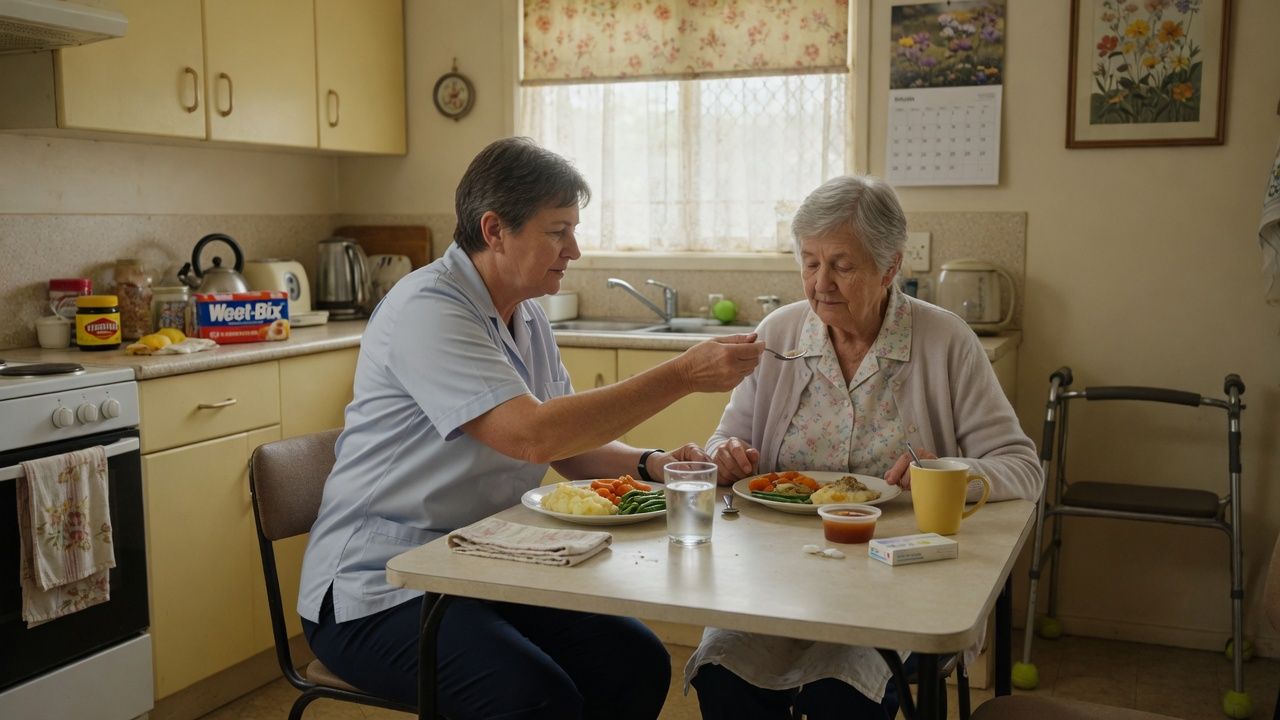


Dysphagia home care support happens without a dining room team or on-site kitchen supervisor. The worker may be alone with a client, a microwave, and food prepared by family to a different texture than the care plan requires. Mealtime safety is therefore a clinical control, not a hospitality extra.
Anchor practice in your Dysphagia and Swallowing Management Policy, Nutrition and Hydration Policy Template, and Food Safety and HACCP Policy Template.
Key Takeaways
- Confirm the current swallowing plan before every meal support visit, including texture and fluid instructions.
- Do not serve food that conflicts with speech pathology directions, including well-meant family meals.
- Positioning, pace, and supervision level are part of the intervention, not optional manners.
- Every worker must know the choking response and when to call emergency services.
- Near misses belong in the incident system so patterns are visible across the caseload.
Identify Risk Before Meal Support Starts
Screen intake notes for stroke history, progressive neurological disease, head and neck issues, recurrent chest infection, coughing on fluids, unexplained weight loss, and prior choking. If meal support is on the roster, the care plan must state whether the client has a formal dysphagia diagnosis, the required food texture and fluid consistency, supervision level, and who may modify the plan.
When instructions are missing or conflicting, pause high-risk meal support and escalate to the care partner or clinical lead. Serving “something soft” without a defined texture standard is not a safe workaround.
Texture, Fluids and the Home Kitchen
Home kitchens introduce variability facility kitchens reduce: different brands of thickener, leftover meals, boiled vegetables cut inconsistently, and drinks poured by relatives. Workers need plain instructions: required texture name or description used by your speech pathology providers, how to prepare or check it, which foods are out of scope, and what to do if the only available food is non-compliant.
Food safety still applies: temperature, cleanliness, reheating, and expiry. Dysphagia controls do not override basic food safety under your HACCP-aligned procedures.
Positioning, Pace and Supervision
Follow the care plan for upright positioning, head support, dentures, and whether the worker must remain within arm's reach. Rushing a meal to fit the next appointment is a known failure mode. If the roster does not allow safe meal duration, the service design is wrong, not the worker.
Choking and Emergency Response
Every staff member providing meal support needs current competency in choking response and calling triple zero. After any choking event or significant coughing episode with suspected aspiration, follow clinical escalation and your Incident Management and Reporting Policy Template. Do not normalise “they always cough a bit” without clinical review.
For broader home care incident patterns, see Fixing Home Care Incident Management Flaws.
Family-Provided Food and Social Meals
Families may see texture rules as optional for birthdays or cultural meals. Document education given, what was agreed, and what the worker will do if non-compliant food is presented (for example decline to feed, offer compliant alternative, escalate). Dignity and cultural food preferences matter; they do not authorise unsafe textures against a current clinical plan without a reviewed change.
Documentation and Audit
Record what was offered, texture used, supervision, client response, intake estimate where required, and any refusal or incident. Quality oversight sits with the Aged Care Quality and Safety Commission. Program and health system context is available via the Australian Government Department of Health and Aged Care.
Competency and Who May Assist at Meals
Meal support for clients with dysphagia is a restricted skill set in a well-run provider. Define which roles may assist, what induction covers (textures, thickening, positioning, choking response), and how competency is signed off. A worker who is excellent at domestic support is not automatically safe at high-risk meals. Roster matching should block untrained staff from dysphagia meal tasks the same way it blocks untrained staff from insulin support.
Refresh competency after incidents, after long absences, and when texture standards used by your speech pathology partners change.
Hydration Plans Alongside Food Texture
Fluids cause many aspiration events. Care plans should state fluid consistency, whether straws are allowed, target intake ranges where clinically set, and how to record refusals. Hot weather and illness increase dehydration risk when clients already fear drinking. Coordinate with nursing and GP pathways when intake falls, rather than only noting “drank a little” across a week of visits.
Equipment and Environment Checks
Before meal support, check that the client is stable in the chair or bed position named in the plan, that dentures are in if required, that suction is available only where your model and training include it, and that lighting is adequate to see texture and fatigue. Remove trip hazards around the table so a coughing episode does not become a fall. These checks take a minute and prevent layered incidents.
When Meal Support Should Pause
Pause and escalate when the client is unusually drowsy, has new facial weakness, cannot follow the usual sequence, has wet voice new for them, or when the only food in the house is unsafe and no compliant alternative exists. Continuing because “we are already here” is not a clinical justification. Document the pause, what was offered, and who was notified.
Working With Speech Pathology and Kitchen Reality
Ask speech pathology partners for instructions that a home worker can follow without commercial kitchen tools. If the prescription cannot be produced in that house, the plan is incomplete. Feed that gap back to the care partner so the prescription, the rostered time, and the household resources match. Providers who never close that loop keep writing perfect plans that fail at the microwave.
Recording Intake Without False Precision
Home notes sometimes claim exact millilitres that nobody measured. Train staff to use honest ranges and qualitative markers agreed in the care plan. False precision helps nobody and undermines trust when a speech pathologist reviews the file. What matters is trend: declining intake, increasing cough, longer meal times, and growing fatigue by the end of the plate.
Share those trends in care partner reviews rather than waiting for a crisis admission.
Cultural Foods and Texture Modification
Texture modification must still respect cultural food preferences where safe options exist. Work with families and speech pathology to identify traditional foods that can meet the prescribed texture, instead of defaulting only to commercial purees the client refuses. Refusal driven by cultural mismatch is still a nutrition risk. Document attempts to offer acceptable compliant options.
Coordination With GPs and Hospitals
After hospital discharge, swallowing status may change and discharge summaries may lag. Do not resume high-risk meal support on old texture orders if the discharge advice is unclear. Seek confirmation, use interim safer options only where a clinician authorises them, and update the care plan the same day the new advice arrives. Providers who keep feeding to a pre-admission plan after a stroke admission create avoidable harm.
Related Resources
- Dysphagia and Swallowing Management Policy
- Nutrition and Hydration Policy Template
- Food Safety and HACCP Policy Template
- Incident Management and Reporting Policy Template
- Fixing Home Care Incident Management Flaws
- Aged Care Quality and Safety Commission
- Australian Government Department of Health and Aged Care
Frequently Asked Questions
Can a support worker change food texture if the client asks?
No. Texture changes need clinical review. The worker follows the current plan or escalates.
What if family serves a non-compliant meal?
Do not feed unsafe textures. Explain the risk, offer a compliant option if available, document, and escalate to the care partner.
Is coughing during meals always an incident?
Not every cough is an incident, but new, worsening or meal-stopping coughing needs clinical review and may meet incident thresholds, especially after suspected choking.
Do we need speech pathology input for all meal support clients?
Not all, but anyone with swallowing risk indicators should be assessed through your clinical pathway before high-risk meal support continues.
How detailed should mealtime notes be?
Enough that the next worker knows texture, supervision, intake issues and any red flags without calling the previous shift.
Where does food safety fit?
Texture controls sit beside food safety. Clean preparation, safe temperatures and storage remain required in the home kitchen.
Treat the Kitchen Like a Clinical Space
Dysphagia and mealtime safety during home care visits depend on a current plan, disciplined texture practice, real supervision time, and honest incident reporting. Write the method for the home kitchen you actually work in, and do not let roster pressure rewrite a swallowing prescription.