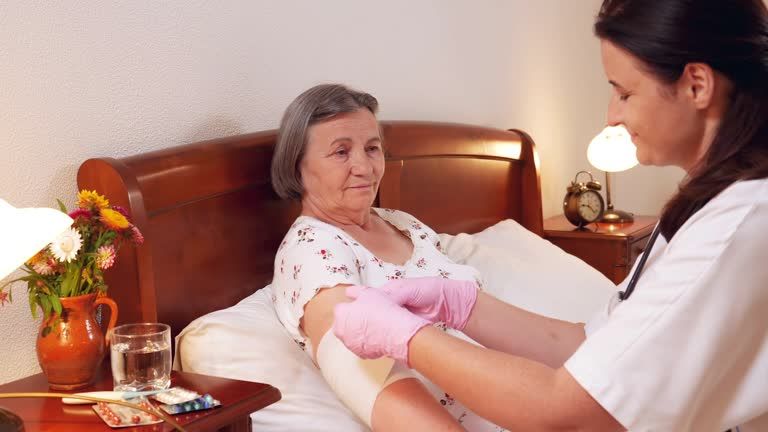


A wound care procedure check belongs before the dressing pack is opened, not after the dressing is done. This sounds obvious and is routinely inverted, because the moment of uncertainty arrives when a worker is already at the bedside with a resident waiting and a trolley set up. Going back to find the procedure at that point costs time and visible hesitation in front of the person being cared for, so people proceed on memory.
Memory is usually adequate. The problem is that wound care is one of the areas where facility-specific variation is highest, product ranges change, and the way something was done at a previous employer may not match what is approved here.
[IMAGE: wound care procedure check - a nurse confirming the approved dressing procedure at the bedside before starting, alt text "wound care procedure check before starting a dressing"]
What actually varies between facilities
Staff moving between employers tend to assume wound care is wound care. Several things commonly differ, and none of them are obvious until someone does it the previous way.
Product range. Which dressings the facility stocks and what is approved for which wound type. A product a worker used regularly elsewhere may not be available or may be reserved for specific circumstances.
Who can do what. Some facilities allow care assistants to perform simple dressings, others restrict all wound care to registered nurses, and some distinguish by wound type.
Assessment and photography requirements. Whether the wound must be measured, whether photographs are required, at what frequency, and how they are stored.
Escalation triggers. What change in a wound requires review, and by whom, and within what timeframe.
Each is documented. The difficulty is that they live across several documents, and a worker at the bedside does not have time to work out which one covers the question they have.
The check that takes twenty seconds
This is where the Ask Norma workflow earns its place. Before opening the pack, the worker asks what the approved procedure is for this wound type, and gets the facility's own answer in plain language rather than a document reference they then have to read through.
The queries that come up most at this point are narrow and practical. What dressing is approved for this wound type. How often should it be changed. Do I need to measure and photograph. What do I do if it looks different from last time. Who do I tell if I am concerned.
Each has a documented answer, and each is faster to ask than to look up. The behaviour change happens because checking becomes cheaper than proceeding on assumption, which is the only reliable way to shift practice at the point of care. Telling staff to consult the procedure does not work when consulting it takes five minutes.
Existing guidance on documentation prompts in this area is covered in wound care documentation prompts, which pairs with the pre-procedure check rather than replacing it.
Why the pre-check improves the record, not just the care
A worker who has confirmed the required documentation before starting will capture it during the procedure. A worker who finds out afterwards is reconstructing.
The difference shows up most in measurement and appearance. Wound dimensions recorded from memory after the dressing is closed are estimates. Photographs not taken cannot be taken retrospectively. Where a facility requires comparison against the previous assessment, that comparison has to happen while the wound is visible.
Knowing the requirements in advance changes the order of operations, and the order of operations determines whether the record is observation or recollection. That is not a documentation technicality, it is the difference between a record that can support clinical decisions later and one that cannot.
When the wound looks different from expected
The hardest moment is discovering something unexpected mid-procedure. The dressing is off, the wound looks worse, and the worker now has a decision to make with the resident waiting.
The useful question at that point is not whether this is serious, which requires clinical judgement they may not hold. It is what the facility expects them to do next. That is answerable, and asking Norma gives a documented pathway rather than an individual assessment made under pressure by someone who may not be the right person to make it.
This is also where the escalation pathway and the wound care procedure need to agree with each other. Where they were written separately, workers find the inconsistency at exactly this moment. The facility's clinical handover and escalation policy should connect cleanly to the clinical procedure rather than sitting alongside it.
Asking Norma at this point has a secondary benefit worth noting. The worker is not only getting a pathway, they are creating a record that they sought guidance before acting. Where a wound later deteriorates and the care is reviewed, evidence that the worker checked the facility's position at the time is materially different from a reconstruction of what they were thinking.
Scope questions in wound care specifically
Wound care sits close to the boundary of what care assistants may do, and the boundary moves between facilities and sometimes between residents.
A worker who is competent to apply a simple dressing may not be authorised to do so here, or may be authorised generally but not for a particular resident whose wound is under specialist management. Checking authorisation before starting takes seconds and prevents a situation where the dressing is already off before anyone realises the wrong person is doing it.
Where a facility's competency framework sets these boundaries, that framework should be the thing the answer comes from. The workforce training and competency policy is where the general position lives, though resident-specific restrictions sit in the care plan.
Making the pre-check habitual
A check performed when someone remembers is a check performed inconsistently. Attaching it to an existing physical trigger works better than relying on diligence.
The most reliable trigger in wound care is the moment the trolley is prepared. The worker is already pausing, already assembling, and a twenty second query fits into that pause without adding a separate step to the workflow. Staff adopt it because it does not feel like an additional task.
Worth reviewing after a few months: which wound care questions came up most. Those indicate where the procedure is unclear or where the product range has changed without the documentation catching up, and both are organisational fixes rather than training problems.
The questions worth pre-testing
Before relying on this at the bedside, it is worth confirming the answers are actually there. Take the wound care questions staff most commonly face and put each to Ask Norma in the phrasing a worker would use, then check what comes back.
A reasonable starting set: what dressing is approved for a skin tear, how often should a pressure injury dressing be changed, do I need to photograph this, who can perform this dressing, what do I do if the wound looks infected, and when does a wound need escalating for review.
Where an answer comes back cleanly, the question is covered. Where the material exists but the worker's phrasing does not reach it, the vocabulary needs aligning, because a worker at the bedside will not rephrase three times before giving up. Where nothing useful returns, there is a real gap in the wound care documentation, and finding it during a quiet review is considerably better than finding it mid-procedure.
This pre-testing takes an hour and is worth repeating whenever the product range changes, since a new dressing introduced without corresponding documentation is one of the more common causes of a query returning nothing.
Frequently Asked Questions
Q: Why do a wound care procedure check before starting?
Because anything the facility requires during the procedure, such as measurement or photography, cannot be captured once the dressing is closed. Checking afterwards turns observation into recollection.
Q: How does Ask Norma help at the bedside?
It answers narrow practical questions about approved products, change frequency, documentation requirements and escalation triggers in plain language, without the worker needing to know which document holds each answer.
Q: What varies between facilities in wound care?
Approved product range, who is authorised to perform which dressings, assessment and photography requirements, and escalation triggers. Prior experience elsewhere is not a reliable guide.
Q: What should a worker do if a wound looks worse than expected?
Ask what the facility expects them to do next rather than judging severity themselves. The documented pathway exists precisely so that assessment is not made under pressure by whoever happens to be present.
Q: Can care assistants perform wound care?
It depends on the facility, the wound and sometimes the individual resident. Authorisation should be checked before starting rather than assumed from competence or previous employment.
Q: When is the best moment to run the check?
While preparing the trolley. The worker is already pausing, so the query fits into an existing gap rather than adding a step, which is what makes it stick as a habit.