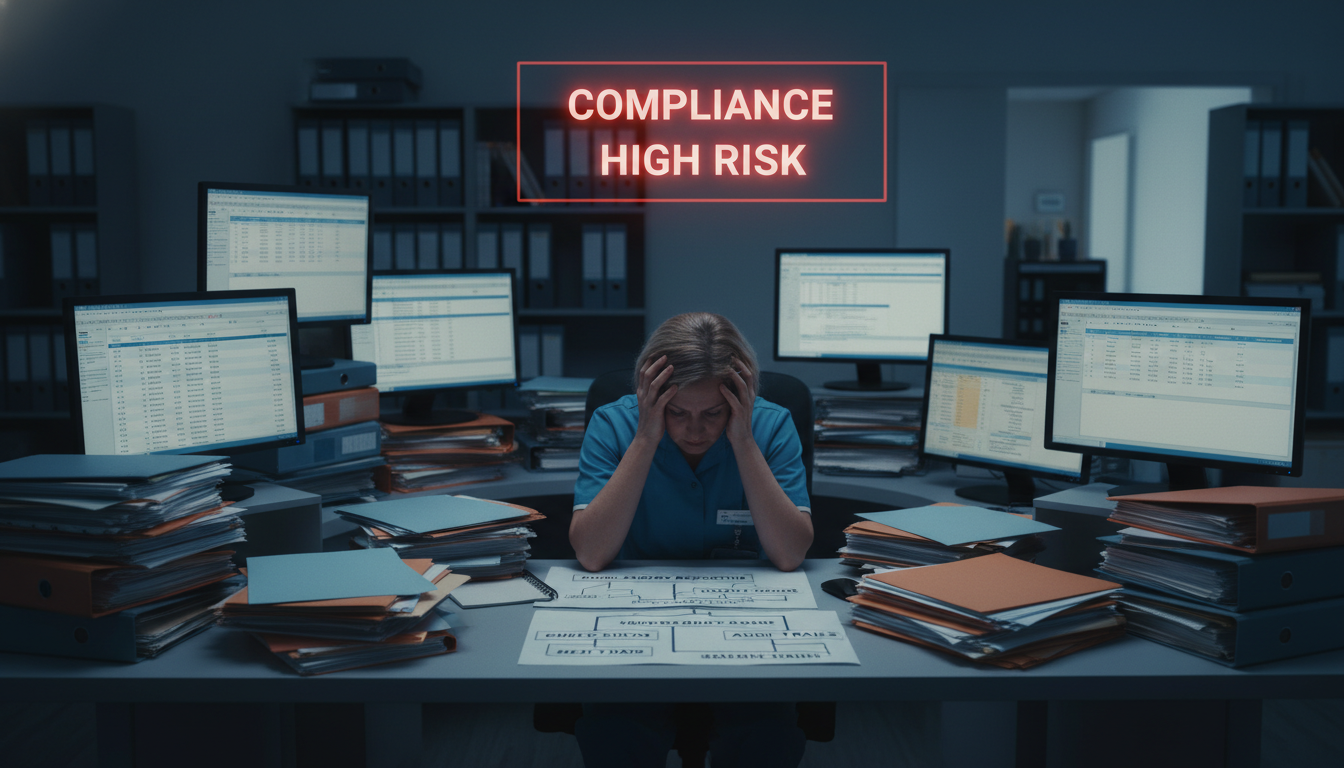


In the Australian aged care sector, the commitment to providing high-quality, compassionate service is constant. Yet, beneath the surface of daily operations, a significant challenge often goes unnoticed: the hidden cost and risk associated with running disconnected, fragmented technology systems.
When data lives in separate silos—one system for rostering, another for clinical notes, a third for finance, and spreadsheets filling the gaps—the result is more than just inefficiency. It creates a Compliance Crisis, turning regulatory reporting into a headache and drastically raising audit risks. For providers striving to meet Star Ratings and maintain resident trust, fixing this fragmentation is not optional; it is essential for survival and quality.
Understanding Aged Care Compliance Risk
Aged care compliance involves meeting strict legislative requirements set by government bodies, adhering to quality standards, and providing accurate, timely reports. These standards govern everything from medication management and incident reporting to staffing ratios and clinical documentation.
The core compliance rating for aged care homes reflects their current performance against these standards, influencing public perception and funding [2]. A failure in compliance can result in fines, sanctions, reputational damage, and, most critically, a reduction in the quality of care delivered to vulnerable residents.
The Problem with Data Fragmentation
In many aged care facilities, technology adoption has been piecemeal. Systems were introduced over time to address specific needs, resulting in a patchwork where critical resident data is spread across multiple platforms that cannot communicate effectively.
This fragmentation directly impacts the four main pillars of compliance:
- Regulatory Reporting: Government mandates require providers to submit regular, highly detailed reports on quality indicators, incidents (including SIRS), and financial activities. When data must be manually extracted from several non-integrated systems—or worse, transcribed from paper records—the process is slow, prone to error, and results in outdated or inconsistent information being reported.
- Data Consistency and Accuracy: A resident’s care plan might be in the electronic health record (EHR), but their dietary preferences might be in the kitchen management system, and their mobility assistance requirements might be noted in a paper handover sheet. This lack of a single, reliable source of truth means staff often make decisions based on incomplete or conflicting data, directly impacting care quality and safety.
- Audit Trails: Auditors require clear, defensible evidence that processes were followed, training was completed, and incidents were logged and addressed properly. Unconnected systems make establishing a complete audit trail difficult. If an incident is recorded in one system, but the subsequent action (like a staff training update or a care plan change) is documented elsewhere, the trail breaks, weakening the provider's defense during scrutiny.
- Legislative Non-Compliance: The sheer complexity of managing legislative requirements across disconnected tools increases the chance of failure. For example, maintaining accurate staffing minutes and ratios is impossible if rostering data doesn't seamlessly integrate with resident needs assessments and actual time-and-attendance records. Small gaps quickly become systemic non-compliance issues.
Direct Costs of the Disconnected Model
Beyond the high-stakes risk of failure, operating with fragmented systems carries significant, quantifiable financial and operational burdens:
Manual Labor and Time Wastage
Staff members, including nurses, care workers, and administrators, spend precious time acting as "data bridge builders." They manually enter the same information into two or three different systems, reconcile discrepancies between reports, and prepare data for submission.
This time spent on repetitive administrative tasks is time stolen directly from resident care. For a facility with dozens of residents, these minutes accumulate into hundreds of hours of unproductive, high-cost clerical work every month.
Increased Incident and Error Rates
Disconnected systems heighten the chance of human error. When staff must read notes from one system and apply them to an action in another, transcription mistakes—especially concerning medication dosage or allergy warnings—become more likely.
Furthermore, critical data is often not immediately visible. If a system for incident logging doesn't communicate with the resident's primary care record, there's a delay in updating the care approach, which raises the probability of recurrence or a decline in the resident's wellbeing.
Loss of Management Insight
If clinical data is separated from financial data, management cannot easily calculate the true cost of specific care interventions or measure the return on investment for staff training. This separation obscures operational bottlenecks and prevents data-driven decisions that could improve efficiency and outcomes. Management struggles to accurately forecast resource needs or justify spending when the operational picture is fractured.
The Path to Connected Compliance
Moving toward a connected system environment requires more than just replacing old software; it requires a strategic shift toward centralized data management.
Step 1: Unifying the Resident Record
The first major action is creating a single, shared record for every resident. This system must act as the primary source of truth, integrating or linking all operational data around that individual, including clinical notes, medication, activities, preferences, and financial arrangements.
Step 2: Integrated Reporting Workflows
A unified platform allows for automated reporting. Instead of exporting data into spreadsheets for aggregation, the system generates compliance reports instantly, drawing verified, consistent data directly from the resident records. This capability significantly shortens the reporting cycle and improves the defensibility of the submitted data during audits.
Step 3: Improving Staff Experience and Training
When staff work within one cohesive platform, training complexity drops, and their confidence in the data improves. Integrated systems support better operational workflows, such as automatic alerts for missed check-ins or overdue tasks, reinforcing quality standards naturally rather than relying on manual oversight.
Achieving Compliance Stability
For aged care providers, the focus must shift from simply treating symptoms of data fragmentation (e.g., hiring more compliance staff to manage reporting) to curing the underlying cause (data silos).
Implementing truly integrated systems—where financial, clinical, and operational data speak the same language—moves providers from a perpetual state of "Compliance Crisis" to one of "Compliance Stability." This stability allows facilities to reallocate resources away from administrative firefighting and back to where they belong: providing exceptional, resident-centred care. It secures the future of the organization and upholds the trust placed in them by residents and their families.
Frequently Asked Questions
What is the "Star Rating" in aged care compliance?
The Star Rating system in Australia provides publicly available information about the quality of care an aged care home provides. Compliance is one of the four performance areas making up the Overall Star Rating, reflecting how well the home meets regulatory standards.
How does disconnected data affect my budget?
Disconnected data increases costs through excessive manual labor (staff time spent on double data entry and reconciliation), higher risk of fines or sanctions due to reporting errors, and inefficiency that requires more staff to achieve the same output compared to a single, connected system.
What specific reports are difficult to generate with unconnected systems?
Key reports that suffer include mandatory regulatory reporting (such as Quality Indicator reports and Serious Incident Response Scheme (SIRS) data), staff qualification and training matrices, and reports that cross-reference clinical outcomes with financial expenditures.
What should we seek in a new integrated system?
A good integrated system should offer a single resident record, automated audit trail functionality, centralized reporting capabilities, and the ability to connect clinical documentation with scheduling, human resources, and financial data.
References
[1] Table Context: hidden cost of unconnected systems in aged care, Compliance Crisis: How Unconnected Systems Create Reporting Headaches and Audit Risks
[2] Compliance | My Aged Care. (n.d.). Retrieved from https://www.myagedcare.gov.au/compliance