

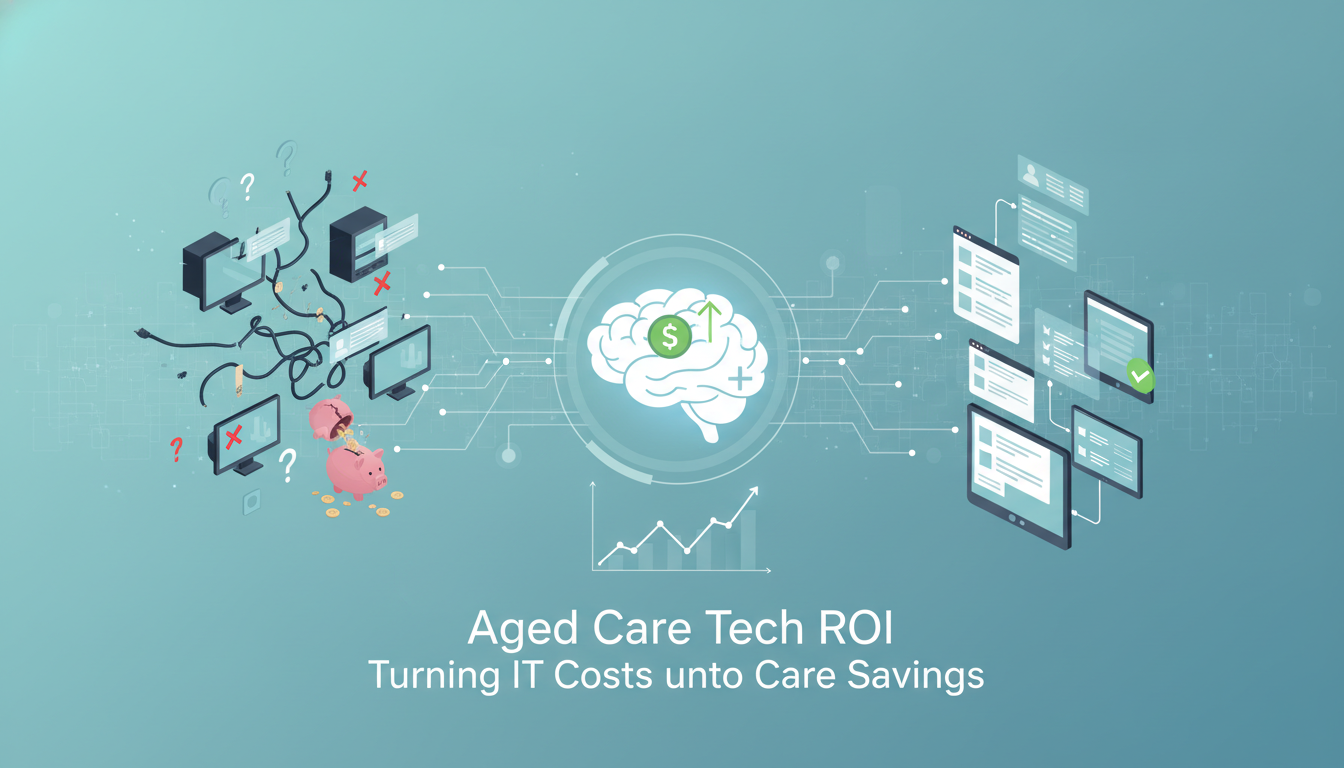


In the aged care sector, the commitment to providing excellent resident care is non-negotiable. Yet, achieving this goal requires sound financial management and intelligent technology choices. Many facilities operate with a patchwork of disconnected software—a collection of legacy systems and siloed applications that manage everything from clinical records to billing and workforce scheduling. While this setup may seem functional on the surface, it hides significant financial expenditures often referred to as "technical debt."
The true financial picture reveals that maintaining these unconnected systems drains resources that could otherwise be directed toward improving resident services. A unified, integrated technology platform offers a clear path to both financial savings and operational improvement. The key is understanding how to accurately calculate the Return on Investment (ROI) of integration.
Understanding Technical Debt in Aged Care IT
Technical debt is the accrued cost of choosing inadequate or temporary software solutions instead of implementing a robust, unified system. In aged care, this debt manifests in several costly ways that directly impact the bottom line.
The True Cost of Software Support and Maintenance
Facilities often pay separate support fees, licensing fees, and subscription costs for every distinct piece of software they run. These recurring expenditures add up quickly, often escalating year over year.
- Multiple Vendor Contracts: Managing contracts and relationships with numerous software vendors creates administrative overhead.
- Inconsistent Fee Structures: Different pricing models make budgeting difficult and comparison challenging.
- Support Overlap: Paying for separate technical support teams to troubleshoot issues that often arise at the integration points between systems.
Hidden Costs of Manual Work and Data Duplication
Disconnected systems force staff to act as the bridge between applications. This is perhaps the largest financial drain and the most significant risk to quality of care.
- Double Data Entry: When resident information, care plans, or medication orders must be manually entered into two or more systems (e.g., once in the electronic health record and again in the billing system), it consumes valuable staff time.
- Increased Error Rates: Manual transcription is prone to human error. These mistakes can lead to administrative rework, incorrect billing, and—most critically—care errors that jeopardize resident well-being and regulatory compliance.
- Wasted Staff Time: Nurses and care staff spend time navigating between different interfaces, logging in multiple times, and chasing fragmented information instead of spending that time with residents. This lowers clinical capacity and often leads to staff dissatisfaction and turnover.
The Burden of Inefficient Training and Onboarding
Every new software application requires dedicated training. When a facility uses five different systems for five different functions, the training load for new hires is immense.
- Longer Onboarding Cycles: It takes longer for new employees to become proficient, delaying their ability to contribute fully.
- Ongoing Retraining Needs: Staff must regularly refresh their knowledge on multiple interfaces, which is an inefficient use of training budgets.
- Lower Adoption Rates: Complexity often leads to staff frustration and resistance, resulting in poor system usage and a failure to gain the full benefit from the technology investment.
The Financial Case for a Unified Platform
Transitioning from a disparate software collection to a unified platform represents a strategic investment that generates measurable ROI. This ROI stems primarily from savings achieved through operational efficiency and cost avoidance.
Direct Cost Reduction through Consolidation
A unified system immediately targets and reduces technical debt by condensing multiple expenses into a single, straightforward expenditure.
- Single Vendor Relationship: Instead of managing five contracts and five support fees, the facility manages one. This simplifies administration, often results in better pricing due to volume, and makes budgeting far more predictable.
- Reduced Licensing Fees: Paying a subscription for a platform that handles all functions is typically less expensive than maintaining individual licenses for multiple specialty products.
- Lower Infrastructure Requirements: Centralizing data often reduces the need for multiple servers, data storage solutions, and complex network configurations required to make disparate systems communicate.
Productivity Gains: Maximizing Staff Capacity
The core benefit of integration is the removal of friction points in daily workflows, allowing care staff to dedicate more time to care delivery.
- Automated Data Flow: A unified system ensures data enters once and is immediately available across all relevant modules (clinical, financial, administrative). This eliminates double entry and the corresponding errors.
- Streamlined Workflows: Integrated platforms guide staff through processes, reducing confusion and the time spent switching screens or applications. A nurse can record vital signs, update the care plan, and generate a shift report all within one interface.
- Faster Decision Making: Real-time access to accurate, complete information empowers clinical and managerial staff to make quicker, better-informed decisions, whether responding to a resident need or managing resource allocation.
Improved Compliance and Risk Mitigation
Regulatory penalties, audit failures, and litigation represent substantial financial risks. Integrated systems fundamentally reduce these risks.
- Audit Readiness: Comprehensive, accurate, and easily retrievable records are the backbone of regulatory compliance. A unified system makes producing audit trails faster and more reliable.
- Error Avoidance: By reducing manual data handling, the risk of medication errors, care plan inconsistencies, and billing mistakes is significantly lowered, protecting the facility from costly incidents.
- Better Data Security: Managing security across a single, modern platform is inherently easier and safer than attempting to secure multiple legacy systems with varying levels of defense.
Calculating Your Integration ROI
To present a compelling business case, the ROI calculation must move beyond simple comparisons of software costs. It must factor in operational savings.
Step 1: Quantify Current Hidden Costs (Technical Debt)
Calculate the annual expenditure related to disconnected systems:
- Total annual support and maintenance fees for all existing disparate software.
- Estimate the total staff hours spent on manual data entry, data reconciliation, and navigating between systems. Multiply this time by the average staff wage to find the labor cost of inefficiency.
- Estimate the cost of errors (e.g., re-billing, time spent correcting mistakes, regulatory fines if applicable).
Step 2: Calculate Projected Integrated System Costs
Determine the cost of the unified platform, including:
- Initial implementation and setup fees.
- Annual subscription or licensing fees for the new system.
- Initial training costs.
Step 3: Measure Anticipated Savings
Estimate the operational savings resulting from the unified platform:
- Savings from Reduced Staff Time: Based on studies or vendor data, estimate the percentage of staff time saved by eliminating double entry (e.g., 10 hours per week per FTE). Convert this time into salary savings.
- Avoided Costs: Subtract the old support fees from the new, single support fee. Include savings from reduced errors and improved compliance.
Step 4: The ROI Formula
The basic ROI calculation is:
$$ROI = \frac{(Gain from Investment - Cost of Investment)}{Cost of Investment}$$
A positive ROI figure confirms that the financial gains derived from efficiency and cost avoidance surpass the cost of implementing the new technology. For many aged care organizations, this calculation proves that standing still with old technology is far more costly than moving forward with integration.
Conclusion: Investing in Quality and Efficiency
Aged care technology should serve as a genuine asset, not a source of technical debt. By analyzing the true, often hidden, costs of maintaining unconnected systems—from redundant support fees to wasted labor hours—organizations can clearly see the financial merit of a unified platform. Investing in integration is not just a technology upgrade; it is a fundamental shift toward operational effectiveness, reduced risk, and, most importantly, freeing up valuable resources to dedicate to high-quality resident care. A unified platform is the solid foundation required for a financially resilient and care-focused aged care future.
Frequently Asked Questions
Q: How long does it typically take to realize ROI from an integrated aged care system?
A: Most organizations begin seeing operational savings, particularly related to reduced manual data entry and consolidated software fees, within the first 6 to 12 months post-implementation. Full ROI, accounting for deeper workflow improvements, is often achieved within 2 to 3 years.
Q: What is the biggest risk of continuing to use disconnected software?
A: The largest risk is data inconsistency and the potential for care errors. When resident data is stored in multiple places, the chance that a clinician or caregiver acts on outdated or incomplete information rises substantially, posing a direct threat to resident safety and leading to regulatory non-compliance.
Q: Does a unified platform restrict vendor choice in the future?
A: While a unified platform simplifies your main technology relationship, reputable systems are typically built with modern integration standards (APIs). This means that if a facility needs a highly specialized tool outside the core platform's offering (e.g., a specific fall detection device), the platform can usually connect with it easily, offering the best of both unity and flexibility.
Q: Can we count staff retention as part of the ROI calculation?
A: Yes. Although harder to quantify precisely, reduced staff frustration and improved workflows often lead to lower turnover rates. Calculating the costs avoided by not having to recruit and train replacements is a valid, though indirect, component of the overall ROI analysis.


