

Key Takeaways
- Electronic Medication Management (EMM) systems help make giving medicine safer in aged care.
- These systems reduce mistakes often seen with paper records.
- EMM gives care staff better information for making choices about medicine.
- Digital medication charts are clearer and easier to read.
- Using EMM helps aged care homes meet important Australian digital health standards.
The Challenge of Medication Management in Aged Care
Providing care in aged care settings often involves managing many medicines for residents. This process, when done using paper, can sometimes lead to issues. Mistakes can happen when writing down medicine details, reading messy handwriting, or keeping track of changes. These issues can affect resident well-being and increase the workload for care staff.
You want to make sure your residents get the right medicine at the right time. You also want your staff to have clear, correct information to do their jobs well. This is where modern solutions come in, designed to make medication processes safer and more efficient.
What is Electronic Medication Management (EMM)?
Electronic Medication Management (EMM) refers to digital systems used to manage all parts of the medication process. This includes:
- Prescribing medicines
- Dispensing medicines
- Giving medicines to residents
- Recording when medicines are given
- Keeping track of medicine stock
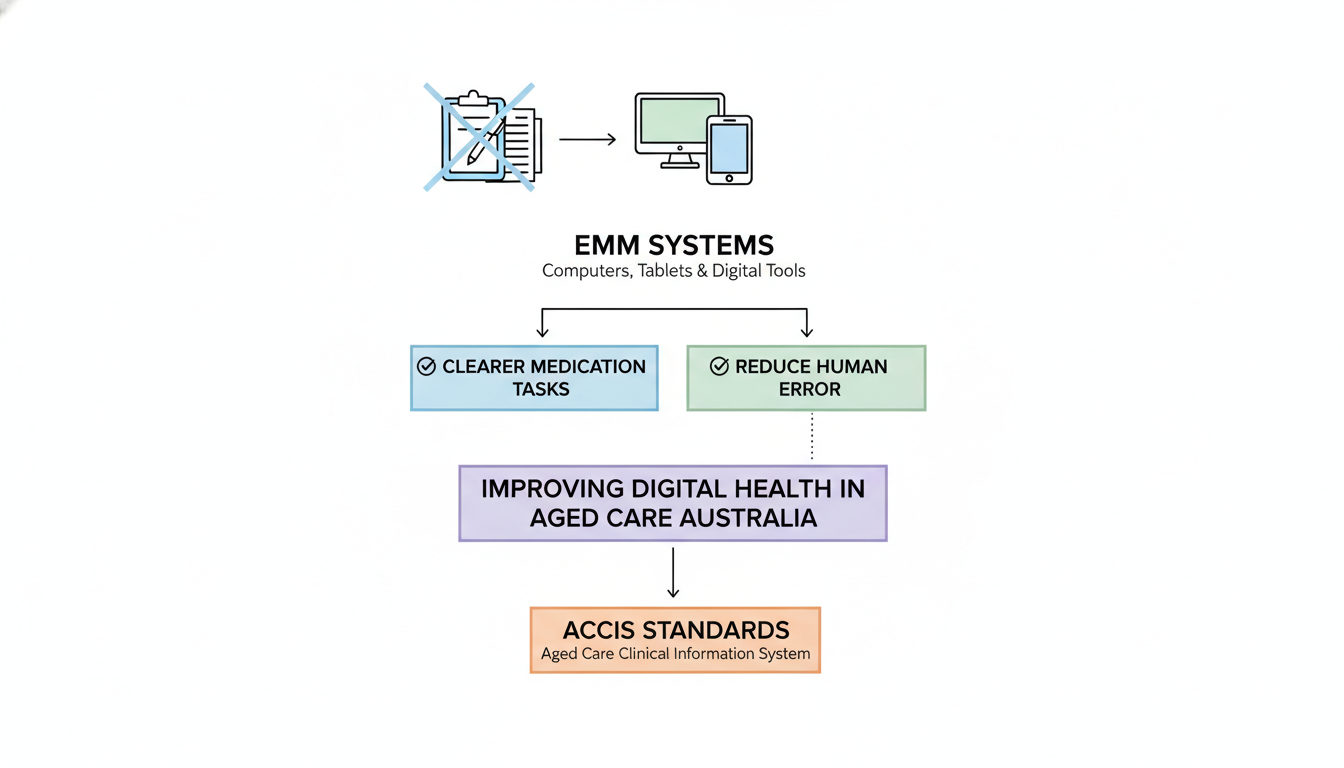
Instead of paper charts and handwritten notes, EMM systems use computers, tablets, and other digital tools. These systems are built to make medication tasks clearer and reduce the chance of human error. They are a key part of improving digital health in aged care across Australia. More information on how these systems fit into broader digital health standards for aged care can be found by reviewing the Aged Care Clinical Information System (ACCIS) Standards.
How EMM Improves Medication Safety
EMM systems bring several important improvements to how medicines are handled in aged care. These changes directly help boost medication safety for residents.
Reduction of Errors
One of the biggest benefits of EMM is its ability to significantly reduce medication errors. Paper-based systems often lead to:
- Illegible Handwriting: Hard-to-read notes can cause staff to give the wrong medicine or dose.
- Transcription Errors: Mistakes made when copying information from one record to another.
- Missed Doses: Forgetting to record when a medicine was given, leading to confusion.
EMM systems address these issues by:
- Standardized Entries: All information is typed and follows a consistent format.
- Automated Checks: The system can flag potential problems, like drug interactions or incorrect dosages.
- Clear Records: Every action is digitally recorded, creating an accurate history.
Better Clinical Decision-Making
EMM systems give care staff and doctors immediate access to a resident's full medication history. This leads to better clinical decision-making.
You can quickly see:
- All current and past medicines
- Allergies
- Any adverse reactions
- When the last dose was given
Having this complete picture helps health professionals make informed choices about a resident's care, reducing the risk of errors and improving outcomes.
Clearer Electronic Medication Charts
Electronic medication charts are a core part of EMM. They replace paper charts with digital versions that are:
- Always Up-to-Date: Changes are made in real-time and are immediately visible to all staff.
- Easy to Read: No more struggling with handwriting. Information is presented clearly.
- Accessible: Staff can access charts from various devices, wherever they need to.
These clear, accessible charts mean staff spend less time trying to understand records and more time focusing on resident care.
The Benefits of EMM for Aged Care Providers
Beyond safety, adopting EMM offers several practical benefits for aged care providers in Australia.
- Meeting Standards: It helps your facility meet evolving digital health standards and regulations.
- Improved Efficiency: Digital processes save time compared to manual paperwork, freeing up staff for direct care.
- Better Communication: All care team members have access to the same current information, improving teamwork.
- Data for Quality Improvement: EMM systems collect data that can be used to review and improve care processes.
- Reduced Costs: Over time, reducing errors and improving efficiency can lead to cost savings.

Governa AI and Your EMM Journey
Implementing a new system like EMM can seem complex. Governa AI understands the unique needs of Australian aged care providers. We offer solutions designed to help you transition to electronic medication management smoothly. Our goal is to support you in improving medication safety and overall care quality for your residents.
We focus on providing systems that are:
- User-friendly: Easy for your staff to learn and use.
- Reliable: Built to perform consistently.
- Supportive: Helping you every step of the way.
Consider how an EMM system could benefit your aged care facility. Reach out to Governa AI to discuss how our solutions can help you make this important step forward.
Frequently Asked Questions
What kind of training do staff need for EMM?
Staff will need training on how to use the specific EMM system your facility chooses. This training typically covers how to prescribe, administer, and record medications digitally. Most systems are designed to be user-friendly, making the training process manageable.
Can EMM systems connect with other health records?
Many EMM systems are designed to connect or integrate with other clinical information systems, such as electronic health records (EHRs). This helps create a more complete picture of a resident's health information across different care settings.
Is EMM secure for resident information?
Yes, EMM systems are built with strong security features to protect resident health information. They comply with privacy regulations to keep data safe and confidential. Access is typically controlled, meaning only authorized staff can view and enter information.