

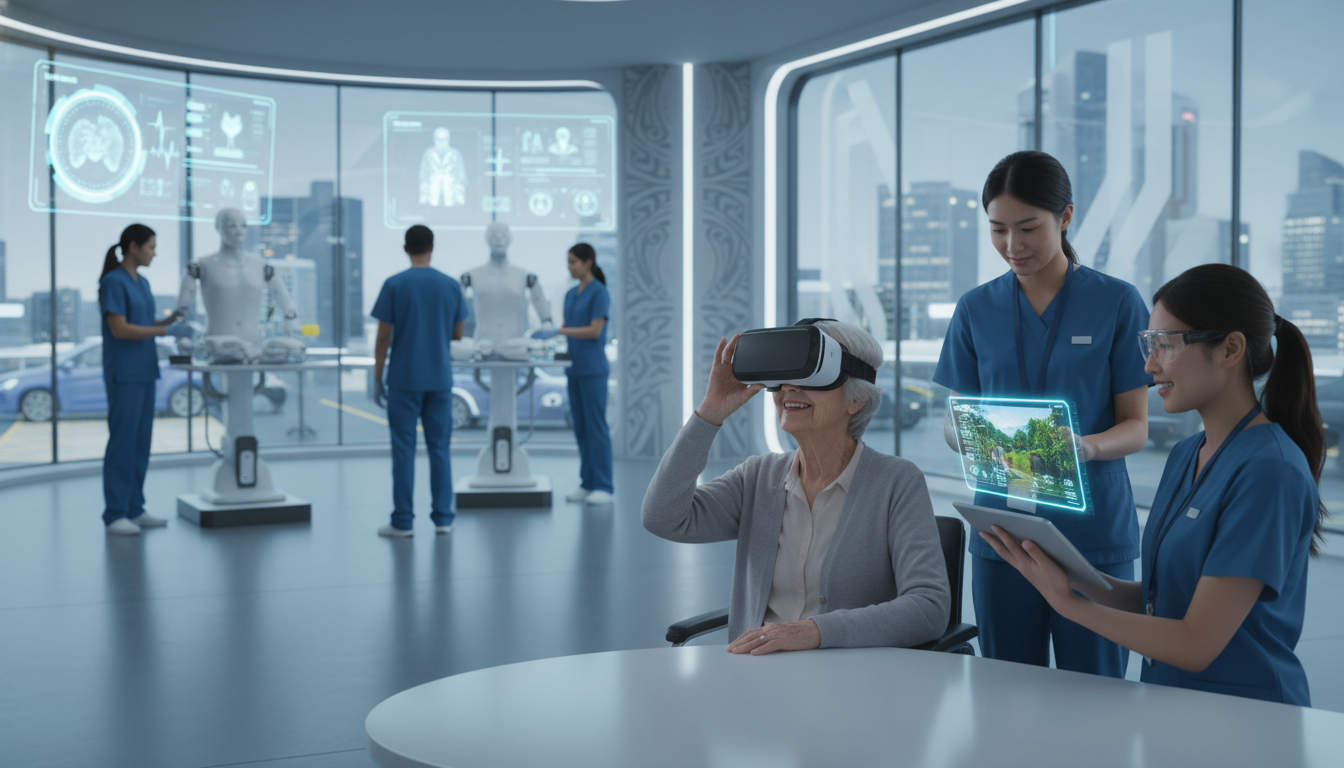


As the global population ages, the demand for high-quality aged care services continues to grow. Technology, particularly Artificial Intelligence (AI), is playing an increasingly important role in meeting this challenge.
AI in aged care isn’t about replacing human caregivers; instead, it is a tool designed to support staff and residents, making care more efficient, safer, and ultimately more person-centered. By automating routine tasks and providing insightful data, AI allows human carers to focus their time and attention on what matters most: empathy, relationship-building, and providing dignified, personalized support.
💡 How AI Reshapes Daily Care Routines
AI systems are being integrated into various aspects of aged care, ranging from predictive health monitoring to administrative support. These applications aim to improve operational effectiveness and resident well-being.
Predicting Health Risks and Needs
One of the most valuable applications of AI is its capacity for predictive analysis. AI algorithms can process data collected from sensors, wearable devices, and electronic health records to identify patterns that might indicate a decline in a resident's health before a critical event occurs.
- For instance, systems can monitor changes in movement, sleep patterns, or vital signs.
- Subtle deviations from an established baseline can trigger an alert, warning care staff of potential issues such as the onset of an infection, dehydration, or an increased risk of falls.
This early warning system allows caregivers to intervene quickly, which can significantly improve outcomes and prevent hospitalizations.
Automating Repetitive Tasks
Many daily tasks in aged care, while necessary, are time-consuming and routine. AI can assist with these responsibilities, freeing up staff time. Examples include:
- Automated charting
- Medication reminders
- Scheduling
In some settings, AI-driven robotics assist with mobility or fetching simple items, reducing the physical strain on human carers. By taking on these repetitive assignments, AI helps reduce staff burnout and allows caregivers to dedicate their hours to meaningful human interaction. This move toward augmentation ensures that AI complements human capabilities rather than substituting for them.
Personalizing Care Plans
AI systems can analyze vast amounts of data about an individual resident—their medical history, preferences, daily activities, and social interactions—to generate highly individualized care recommendations.
- This supports person-centered care by moving away from a standardized approach.
- The result is a care plan that truly reflects the resident’s unique needs and wishes.
For example, if an AI notes that a resident is consistently happier and more engaged after certain activities, it can recommend adjusting the activity schedule to align better with the resident’s routines and energy levels.
🤝 Maintaining Dignity and Empathy with Technology
A common concern about introducing AI into such a personal field is the potential loss of the human element. However, the goal of modern AI application in aged care is fundamentally to preserve and strengthen dignity and empathy.
AI systems are best used when they work in partnership with human staff. By managing the data and administrative load, AI acts as a sophisticated assistant. This structure allows human staff to concentrate on the relational aspects of their job, such as:
- Having meaningful conversations
- Offering emotional comfort
- Recognizing non-verbal cues that technology might miss
As a recent article noted, AI should extend human interaction rather than limiting it. The technology should assist staff in providing relationship-building opportunities, making sure that when a human carer interacts with a resident, they are fully present and informed about the resident's current state and needs.
⚖️ The Policy Landscape: AI Adoption in Context
The adoption of AI in aged care varies depending on regional regulatory environments and specific health priorities. It is important to view these developments through a policy lens to understand the drivers behind technological change.
New Zealand's Approach
New Zealand provides a clear example of policy-supported AI integration. Health reforms there are guided by the Pae Ora (Healthy Futures) Act 2022. This legislation supports the integration of digital health solutions, including AI, to support service delivery.
A key focus within New Zealand’s Digital Health Strategic Framework is addressing equity, particularly for Māori and Pacific communities. AI systems can assist in adapting service delivery models, such as supporting home-based care options, to make services more accessible and culturally appropriate for all populations. This framework shows how national health policy can intentionally guide AI adoption to meet specific social and health equity goals.
🚧 Ethical Considerations in AI Implementation
While the practical benefits of AI are significant, implementation must proceed with strong ethical oversight. Key ethical issues include data privacy, consent, and bias in algorithms.
- Data Security and Privacy: Systems handling sensitive health information must comply with strict regulations. Residents and their families need assurances that their personal data is protected from breaches and misused.
- Algorithmic Bias: If the data used to train AI models is skewed or unrepresentative of certain populations, the resulting care recommendations may be unfair or ineffective for those groups. Ongoing testing and transparent development are needed to mitigate bias.
- Transparency and Trust: Care providers must understand how the AI arrives at its conclusions. A "black box" approach—where the system makes recommendations without clear reasoning—can erode trust among staff and residents. Open communication and training are essential for building confidence in the technology.
Case Study: Home-Based Care Support
The move toward supporting people to age at home is a growing global trend. AI is perfectly suited to support this shift, offering sophisticated monitoring and support without requiring permanent staff presence.
In home settings, AI-powered sensors can:
- Monitor activities of daily living (ADLs).
- Detect falls.
- Track medication adherence.
If an anomaly is detected—for example, if a resident has not left their bed by a certain time or if the refrigerator has not been opened—the system can alert family members or care coordinators. This technology allows individuals to maintain their independence longer while providing peace of mind to their relatives. It helps ensure that care interventions are timely and necessary, maintaining a focus on individual autonomy while supporting safety.
✨ Conclusion
AI represents a powerful evolution in aged care, not a revolution meant to discard traditional methods. Its real promise lies in its capacity to handle the complex, data-intensive aspects of care management, thereby removing obstacles that often contribute to staff shortages and burnout.
By working in partnership with human professionals, AI makes care more precise, personalized, and proactive. The outcome is a system where technology supports human connection, safeguards dignity, and allows carers to dedicate their skills and empathy to the most meaningful aspects of their demanding profession. As technology continues to mature, adherence to ethical principles and person-centered values must remain at the forefront of its application in the crucial field of caring for older adults.
❓ Frequently Asked Questions (FAQs)
1. Is AI meant to replace human caregivers?
No. AI in aged care is fundamentally designed to support human staff. By automating routine tasks and providing predictive insights into resident health, AI frees up human caregivers to focus on tasks requiring empathy, relationship-building, and personalized attention. The goal is augmentation, making human care more effective and focused on relationship building.
2. What kinds of data does AI collect in aged care?
AI systems collect data from various sources, including:
- Sensors that monitor movement and sleep.
- Wearable devices tracking vital signs (like heart rate and blood pressure).
- Electronic health records detailing medical history and preferences.
This data is used to establish baseline patterns and detect deviations that might signal a health issue.
3. How does AI help prevent staff burnout?
Staff burnout is often caused by the heavy administrative load and the high cognitive burden of managing complex resident needs. AI assists by:
- Automating documentation.
- Managing medication reminders.
- Prioritizing which residents need immediate attention based on predictive risk scoring.
This reduction in routine workload allows staff to spend more time on fulfilling, direct resident interaction.
4. What are the main ethical concerns regarding AI in this field?
The primary ethical concerns center around data privacy and security, ensuring patient consent for data collection, and mitigating algorithmic bias. It is crucial to develop AI systems that are transparent—meaning care providers understand how recommendations are reached—to build trust among staff, residents, and families.


